
Need help choosing the right system?
Increased research on the potential benefits of cannabidiols (CBD and THC) extracted from cannabis plants has led to growing popularity in CBD and THC oils. These high-value extracts require careful extraction methods to go from cannabis plant to oil. Here are a few of the most common CBD and THC extraction methods.
Download Our Complete CBD Guide
CBD vs. THC- What’s the Difference?
THC and CBD are the two main cannabinoids extracted from cannabis plants. Marijuana has a higher percentage of THC while hemp has a higher percentage of CBD. Put simply, THC has the psychoactive properties associated with getting “high” while CBD is said to have more calming, medicinal properties.
Running this application in your facility?
We've built custom cooling solutions for this exact use case. Let us design one tailored to your setup.
Common Extraction Methods
Solvent Extraction
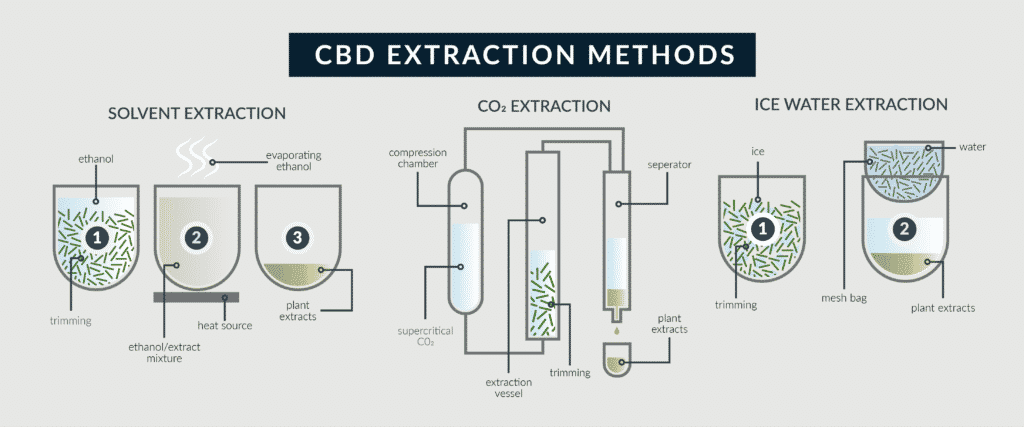
This simple extraction method works by using ethanol as a solvent to remove extracts from cannabis plant trimmings. It usually looks something like this:
- Ethanol is added to trimmings and mixed for a couple of minutes to allow the ethanol to dissolve extracts from the plant materials.
- The ethanol is strained from the trimmings.
- The ethanol/extract mixture is slowly heated until all ethanol evaporates and only the plant extracts remain.
Solvent Extraction Pros:
- Inexpensive- This method doesn’t require any fancy machinery.
- Simple- This method is pretty straightforward and can even be done at home.
Solvent Extraction Cons:
- Dangerous- Ethanol is extremely flammable.
- Could Damage CBD/ THC- Ethanol could potentially denature the CBD or THC if overheated or overmixed.
CO2 Extraction
The CO 2 Extraction method uses supercritical carbon dioxide to pull phytochemicals from cannabis plants. Supercritical materials are not quite a liquid but not quite a gas and possess the properties of both. This state is ideal for plant extraction because supercritical CO 2 can move through materials like gas and dissolve materials like a liquid.
CO 2 extraction typically follows these steps:
- The CO 2 is prepared in a compression chamber. First, CO 2 gas is turned into a liquid; this is done by dropping the temperature to under -69°F and increasing the pressure to over 75 psi. Next, the the temperature and pressure are both raised until the liquid becomes supercritical.
- The supercritical CO 2 passes through cannabis trimmings in an extraction chamber where it dissolves and collects extracts from the plants.
- The CO 2/ extract solution then enters a lower-pressure separator chamber. The lower pressure causes the CO 2 and plant extracts to separate. The CO 2 returns to the CO 2 chamber and the cannabis oil is drained from the separator.
CO2 Extraction Pros:
- Safe when done by professionals- CO 2 is used in countless food products and is perfectly safe for consumption
- Yields high-quality CBD- machines leave very little room for error
CO2 Extraction Cons:
- Very expensive- setup costs start at approximately $40,000
- Not for novice chemists- it’s best to leave this method to the professionals
Ice Water Extraction
Ice water extraction creates a powdery resin extract often referred to as “hash” or “bubble hash.” There are several variations to this method, but they all follow these general steps:
- Finely-chopped plant trimmings are mixed with either ice or dry ice. This step is supposed to help separate extracts from the plant material.
- Water is added to the ice and trimmings and the entire mixture is strained through a mesh bag. (Often, the mixture is strained multiple times through progressively smaller-micron mesh bags until the purest-possible extracts are obtained)
- The extracts settle at the bottom of the strained mixture. The excess water is drained from the top and the extracts are left to dry until they become powdery.
Ice Water Extraction Pros:
- Inexpensive- Again, no fancy machinery needed!
- High Yield- If done correctly, this method produces a relatively large amount of plant extract.
Ice Water Extraction Cons:
- Not always practical- This method can be labor intensive and time consuming.
Temperature Control During Extraction
Regardless of the method used, careful temperature is control is an important element of high-quality yield in CBD and THC extraction. Extreme temperatures damage cannabinoids. Additionally, many processes need specific, extreme temperatures to be effective; if ideal temperatures are not maintained, the extraction process could completely flop. North Slope Chillers’ extraction chillers offer precise temperature control at sub-zero temperatures. Give us a call at
(866) 826-2993 and we’d be happy to tell you more about our products.
Frequently Asked Questions
What temperature is CBD extracted at?+
CO2 extraction operates between 90°F–150°F at high pressure, while ethanol extraction requires cooling to -40°F to -80°F for winterization. Hydrocarbon extraction (butane/propane) also uses sub-zero temperatures. Post-extraction purification steps like distillation and crystallization each have their own temperature requirements.
Why is cold temperature important for CBD extraction quality?+
Cold temperatures during extraction and winterization prevent fats, waxes, and chlorophyll from dissolving into the extract. This produces a cleaner, purer CBD product with better color, taste, and potency. Warmer extraction pulls more undesirable compounds that must be removed in additional processing steps.
What size chiller is needed for a CBD extraction lab?+
A small CBD extraction lab typically needs a 2-ton to 5-ton Deep Freeze chiller for winterization and extraction cooling. Larger operations with multiple extractors and rotary evaporators may need 10+ tons. The chiller must reach -20°F or lower for effective winterization.
Ready to solve your cooling challenge?
Our team has helped thousands of businesses find the right chiller solution. Let us help you next.
Keep exploring: Applications
This article is part of our Applications resource collection. Browse all the guides in this topic.