
Need help choosing the right system?
How should chemicals be stored? Many companies purchase, transport and store chemical drums in warm or hot environments. Such chemical storage can be problematic as many types of chemicals are adversely affected by exposure to hot temperature environments. Knowing how to store chemicals safely will prevent costly waste and help keep your operation running smoothly.

Harmful Heat During Chemical Storage
All organic chemicals are susceptible to thermal degradation and will oxidize over time and in warm environments. Among the more concerning substances that need to be kept cool are: Paint, coatings, epoxy, scale inhibitors, and corrosion inhibitors. Additionally, some drums containing materials like concrete and specialized chemicals need to be kept cool before they are utilized in a manufacturing process.
So, how can you keep these substances cool during storage?
Refrigerated Rooms
Process cooling solutions can range from simple and easy-to-implement, to difficult and costly. One option is to control the environment that they are stored in. Refrigerated storage rooms can be constructed and small to large amounts of chemical drums can be kept cool at the same time. For very large facilities that store large amounts of chemicals this can be a good, viable solution.
There are some limitations with refrigerated rooms including:
- Expensive to design and construct
- Time consuming to set up
- Difficult to relocate
- Difficult to scale up if more space is needed
- Not practical for use if the chemicals are in use at several different points in a facility
Chiller Units: Coils and Blankets
Another option is to provide localized cooling on each drum of chemical. A chemical chiller unit is needed to draw excess heat from the contents of the drum. For the chiller unit to be able to effectively draw off heat a separate heat exchanger is needed to interface the chiller with the drum. There are two types of heat exchangers that can be used: a submersible coil unit or a fluid cooling blanket.

Running this application in your facility?
We've built custom cooling solutions for this exact use case. Let us design one tailored to your setup.
Submersible Coils
A submersible coil unit can be constructed from many types of materials but the two predominant materials used are metal and plastic. The coil is connected directly to a chiller unit and then submerged directly into the chemical drum. The challenges with this approach are:
- Contamination of the chemicals from coiling unit and airborne debris
- Localized cooling with a potential of localized freezing
- Exposure of hazardous chemicals
- Evaporation of drum contents
Cooling Blankets
A fluid cooling blanket is a heat exchanger that is wrapped around the exterior of a drum. The blanket is connected to a chiller unit and then draws heat off of a drum and maintains a desired temperature. The added benefits of the approach include:
- Insulation of the drum products
- Even distribution of cooling medium
- Containment of hazardous chemicals
- Reduction in possible contamination of product
- The ability to cool drums at various points in a facility at the point of use
- Ability to maintain cool product temperature even in very hot ambient environments
North Slope Chillers
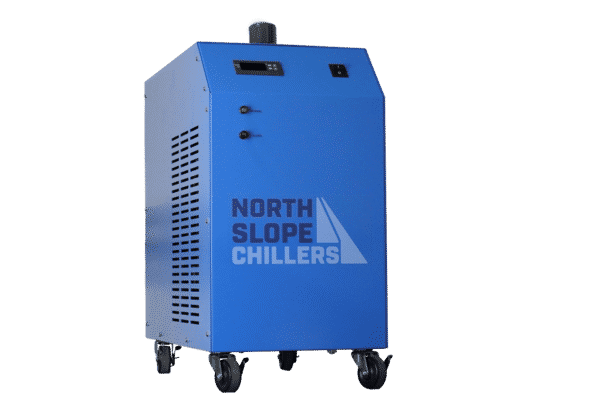
North Slope Chillers provide the most innovative and effective chilling systems on the market. They are easy to install and will not disrupt the current setup of your chemical storage. Whether you need to keep materials cool, frozen or anything in between, North Slope Chillers will keep your supplies at the perfect temperature and help prevent costly and time-consuming waste.
Frequently Asked Questions
What temperature should flammable chemicals be stored at?+
Most flammable chemicals should be stored below 100°F and ideally below 80°F to minimize vapor pressure, reduce fire and explosion risk, and comply with OSHA and NFPA storage requirements. Specific chemicals have individual maximum storage temperatures listed on their Safety Data Sheets (SDS).
How does heat affect chemical shelf life?+
Heat accelerates chemical degradation through increased reaction rates — the Arrhenius equation shows that reaction rates roughly double for every 18°F (10°C) increase in temperature. Storing chemicals at recommended temperatures can extend shelf life by 2–5x compared to warm storage conditions.
Do chemical storage buildings need active cooling?+
Chemical storage buildings in warm climates or housing temperature-sensitive materials often need active cooling. Options include climate-controlled storage rooms, individual drum or container cooling wraps, or ventilation systems. The choice depends on the chemical hazard class, volume, and required temperature range.
Ready to solve your cooling challenge?
Our team has helped thousands of businesses find the right chiller solution. Let us help you next.
Keep exploring: Applications
This article is part of our Applications resource collection. Browse all the guides in this topic.