
Need help choosing the right system?
Save Your Data And Beat The Heat
Server rooms and data centers are the lifeblood of any technology company. The equipment in these rooms generate very high levels of heat and must be carefully climate controlled. Excessive heat in a server room damages valuable equipment, jeopardizes communication networks, and causes data loss and costly downtime.

According to IBM, the recommended temperature for a server room is 72° F, with 45% relative humidity. Servers can tolerate temperatures in a range outside that goal (60° – 90° F), however operating with those optimum conditions in mind keeps you better prepared for unintended heat spikes.
Running this application in your facility?
We've built custom cooling solutions for this exact use case. Let us design one tailored to your setup.
Calculating Heat Load:

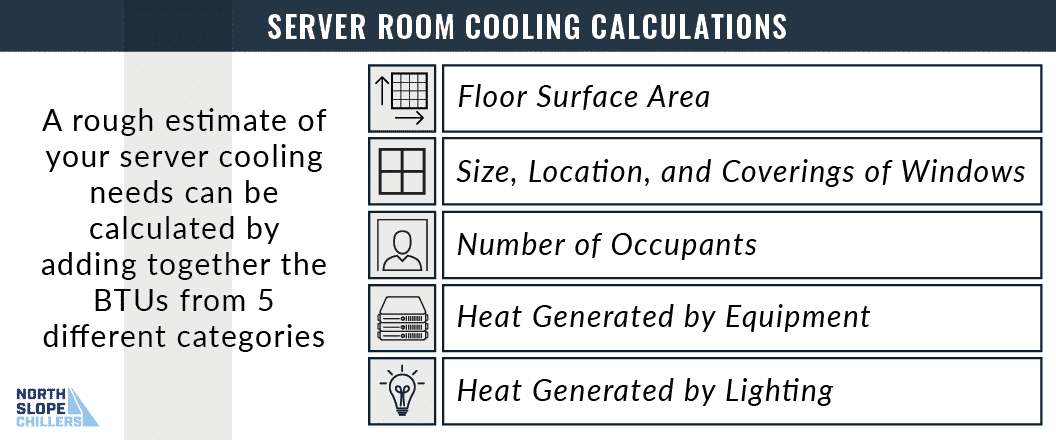
The amount of heat a server generates is known as heat gain or heat load. The heat load inside a server room is influenced by 5 different factors:
- The floor surface area
- The size, position, and coverings of the windows
- The number of room occupants
- The heat generated by equipment
- The heat generated by lighting
You can pull together a reasonable estimate of your cooling needs by using the following calculations.
Floor Surface Area
Length (m) x Width (m) x 337 = Room area BTUs
Window Size and Position
If there are no windows in your server room, proceed to the next calculation.
For Southern Hemisphere, reverse the formulas.
South facing window length (m) x south facing window height (m) x 870 = south facing window BTUs
North facing window length (m) x north facing window height (m) x 165 = north facing window BTUs
If the windows have no coverings multiply the window BTUs by 1.5
Add the window BTUs together:
South facing window BTUs + North facing window BTUs = Window BTUs
Occupants
Number of occupants x 400 = Occupant BTUs
Equipment
The wattage listed on a piece of equipment is its maximum power output, but it is better to overestimate rather than under estimate.
Add together the wattage for every piece of equipment: servers, routers, etc.
Total wattage for all equipment x 3.5 = Equipment BTUs
Lighting
Add together the wattage for every light fixture.
Lighting wattage X 4.25 = Lighting BTUs
Total Heat Load = room area BTUs + window BTUs + occupant BTUs + Equipment BTUs + lighting BTUs
These calculations can give you a rough guide to your cooling needs. A cooling audit of your server room will provide you with the most accurate information.
Keeping Your Server Room Cool
Residential AC units generally cannot run 24/7/365 without breaking down, and are not a reliable solution for server room cooling.
Re-designing the layout of your server room to accommodate bulky, built in cooling units is expensive and disrupts the usability of your servers. Strategically placing portable server coolers is an easy way to remove heat exactly where it needs to be removed.
North Slope Chillers Solutions
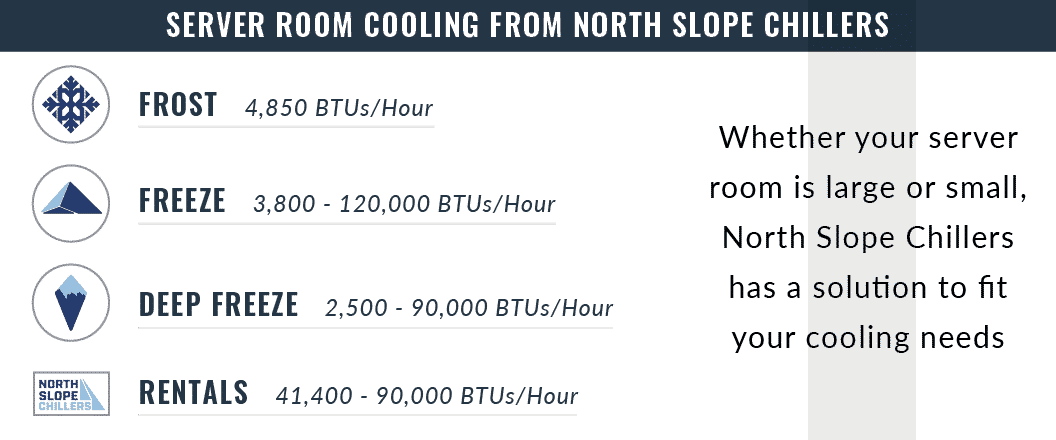
Portable server coolers from North Slope Chillers have a wide range of cooling capacities.
Contact us to find the right server cooling solution for your needs:
(866) 826-2993 sales@northslopechillers.com
Frequently Asked Questions
What temperature should a server room be maintained at?+
ASHRAE recommends server room temperatures between 64.4°F and 80.6°F (18°C–27°C) with the ideal range being 68°F–72°F. Operating at the upper end of this range can reduce cooling energy costs by 4–5% per degree without impacting equipment reliability.
What happens if a server room gets too hot?+
Servers begin thermal throttling (reducing performance) around 95°F to protect themselves. Above 104°F, hard drives and memory modules begin failing, and processors may shut down entirely. Prolonged operation above 80°F reduces component lifespan and increases failure rates significantly.
Can a portable chiller cool a small server room?+
Yes, a portable chiller providing chilled water to an air handler or fan coil unit can effectively cool a small server room or data closet. A 1-ton to 2-ton chiller handles 3–6 kW of IT load. This approach provides redundancy and flexibility that mini-split systems lack.
Ready to solve your cooling challenge?
Our team has helped thousands of businesses find the right chiller solution. Let us help you next.
Keep exploring: Applications
This article is part of our Applications resource collection. Browse all the guides in this topic.