
Need help choosing the right system?
Cooling Molten Plastic
Plastic products today would not exist without careful temperature control for both process heating and cooling. Injection molding requires that some plastics be heated all the way to 550° F. Because of these high temperatures, proper cooling can be one of the most essential steps in the entire plastic manufacturing process.
Learn more about Plastic Injection Molding
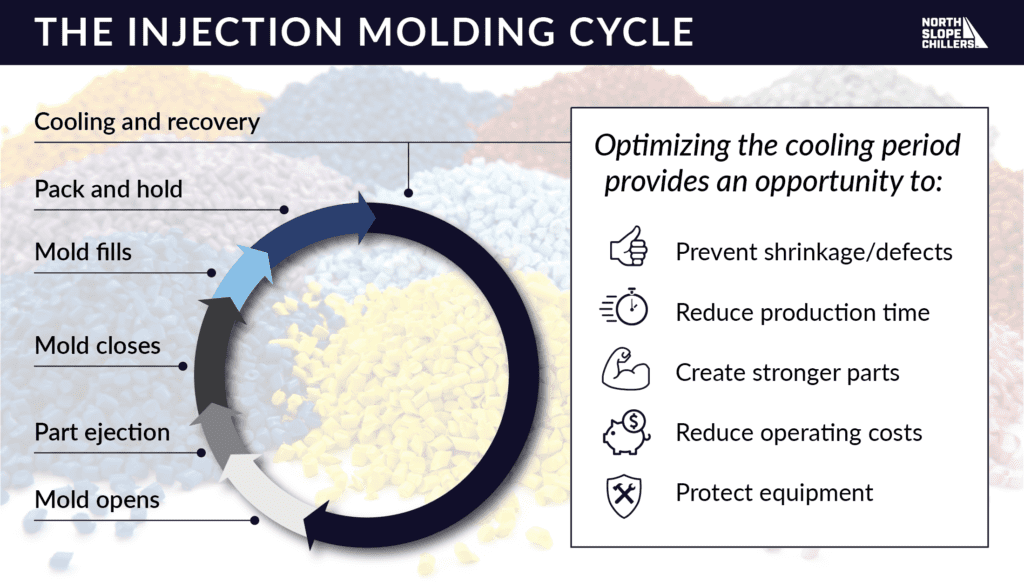
Plastic Cooling Timeline
The plastic cooling and recovery stage can take up around 80% of the total manufacturing time for a single plastic component. Optimizing this cooling stage prevents shrinkage and other plastic defects, reduces production time, creates stronger finished parts, reduces costs, and protects valuable injection molding equipment.
Air Cooled vs Water Cooled
There are 2 main methods for removing heat from around a plastic injection mold: air cooled chilling, and water cooled chilling.
Air Cooled
Air cooled chilling uses forced air to remove waste heat from injection molding equipment into the surrounding air. Air cooled chilling may be an effective cooling method for low volume plastic manufacturing, however when it comes to high volumes, it is usually insufficient. Air is a less effective heat transfer material than fluid, and will take a long time to cool an injection mold properly before the part is ejected. Air cooling is also a less efficient use of energy because you are paying to cool a larger space instead of directing your cooling power exactly where it is needed.
Water Cooled
Water cooled plastic chillers run a chilling fluid (usually a mix of glycol and water) directly around the injection mold. Waste heat transfers into the chilling fluid which then continuously returns to the chiller unit where the cycle begins again. Thermal engineers typically draw up precise heating and cooling specifications for an injection molding machine. These temperature control goals depend upon many factors including type of plastic being used, thickness and dimension of the part, and the design of the mold itself. Using a fluid plastic chiller helps manufacturers hit these temperature goals with more precision than if they were using an air cooled chiller.
Plastic Cooling Strategies
Over the decades, thermal engineers and mold designers have created clever cooling systems to more efficiently remove waste heat from injection molds. The goal is to remove heat quickly and uniformly across the entire mold surface so it can be used again immediately.
Running this application in your facility?
We've built custom cooling solutions for this exact use case. Let us design one tailored to your setup.
Cooling Channels
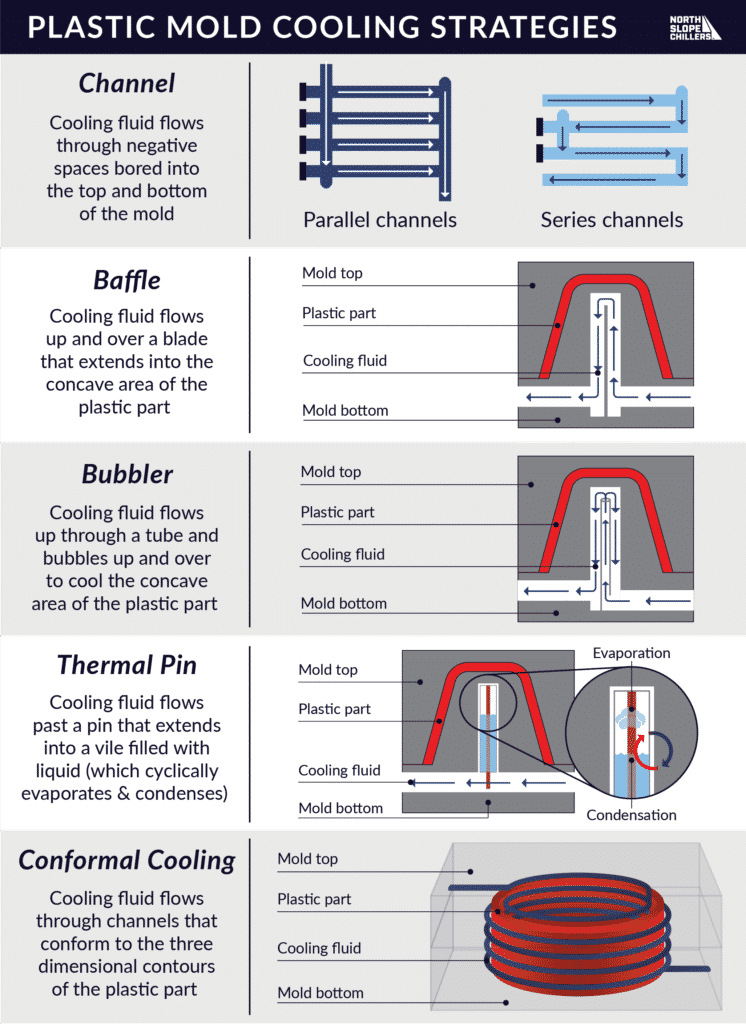
It is essential to eliminate hot and cold spots when chilling an injection mold. Mold designers must not only design for complete cooling coverage but also help the chiller maintain the right fluid flow rate. They accomplish this with a variety of cooling channel layouts that can be categorized into 2 main designs: parallel channels and series channels.
These channels are drilled into the top and bottom of the injection mold and chilling fluid flows through continuously during the cooling and recovery stage.
Baffles
Plastic parts with protrusions, cavities, cores, and more can be difficult to cool evenly. Mold designers have engineered a few different methods for cooling these 3 dimensional features. A baffle is a cooling channel with a blade that runs perpendicular to the main cooling line. Cooling fluid flows into the channel, up and over the blade, and back down to exit the mold. This baffle allows cooling fluid to get in and out of a cavity or core in the plastic part and cool it from the inside.
Bubblers
A bubbler works similarly to a baffle, except its perpendicular channel contains a small tube instead of a blade. Cooling fluid flows up the tube, “bubbles” out the top, and runs down the outside of the tube like a water fountain.
Thermal Pins
Another method used to cool cores is a thermal pin setup. A thermal pin is contained within a narrow cylinder filled with fluid. This pin extends down into the main cooling fluid line so it can stay cool. As heat from the injection mold transfers into the cylinder, the fluid inside evaporates and turns into vapor. The vapor then condenses on the cool pin and this cycle continues during the whole cooling and recovery stage.
Conformal Cooling
Conformal cooling uses a custom tooled mold with cooling channels that follow the 3 dimensional geometry of the plastic part. Mold designers will make these channels conform to specific shapes around the part’s exterior and interior.
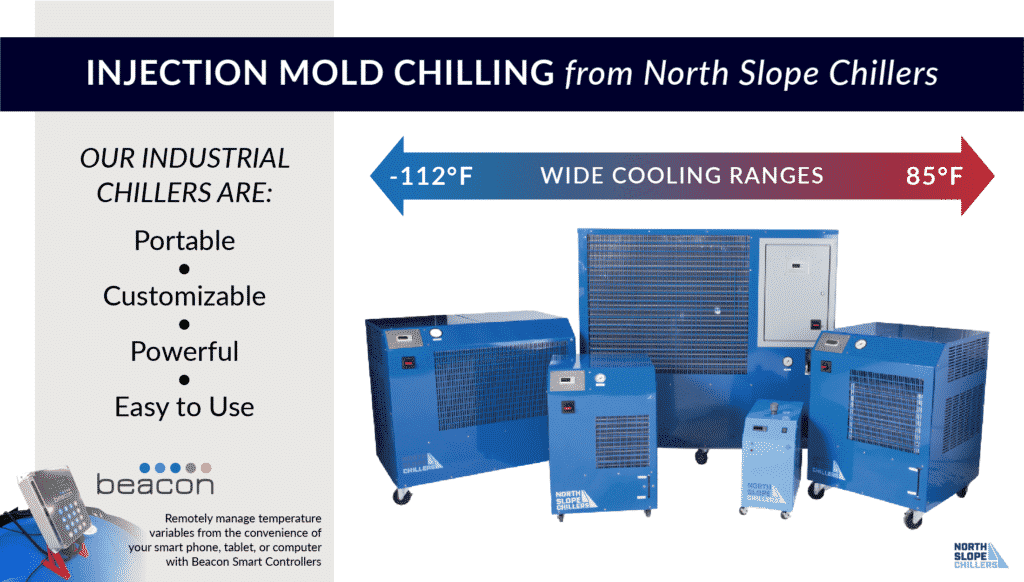
North Slope Chillers Plastic Cooling Solutions
Contact us to find the right injection mold chilling solution for your needs at (866) 826-2993 or sales@northslopechillers.com
Frequently Asked Questions
What role does cooling play in plastics manufacturing?+
Cooling accounts for 60–80% of the injection molding cycle time and directly determines part quality. Proper mold cooling prevents warping, sink marks, residual stress, and dimensional inaccuracy. Temperature control is equally critical in extrusion, blow molding, and thermoforming processes.
What mold temperature is used for common plastics?+
ABS and polycarbonate molds run at 150°F–200°F, polypropylene at 60°F–120°F, nylon at 120°F–175°F, and PET at 250°F–300°F. Each resin has an optimal mold temperature that balances surface finish, dimensional stability, and cycle time. Deviating from the recommended range causes quality defects.
How does ambient temperature affect plastics processing?+
Seasonal ambient temperature changes of 30°F–40°F can shift coolant supply temperature by 5°F–10°F if the chiller is undersized, causing inconsistent part quality between summer and winter. A properly sized process chiller maintains constant coolant temperature regardless of ambient conditions.
Ready to solve your cooling challenge?
Our team has helped thousands of businesses find the right chiller solution. Let us help you next.
Keep exploring: Applications
This article is part of our Applications resource collection. Browse all the guides in this topic.