
Need help choosing the right system?
TVCs
Pressurized chambers have become extremely ubiquitous in our modern era. They vary greatly in size and application and their industrial uses continue to expand every year. As technology improves, the environments they are capable of simulating are becoming increasingly more extreme. Let’s take a look at the most extreme pressure chamber out there…a Thermal Vacuum Chamber (TVC).
Get the Ultra-Low Temperature Spec Sheet
What Are Thermal Vacuum Chambers?
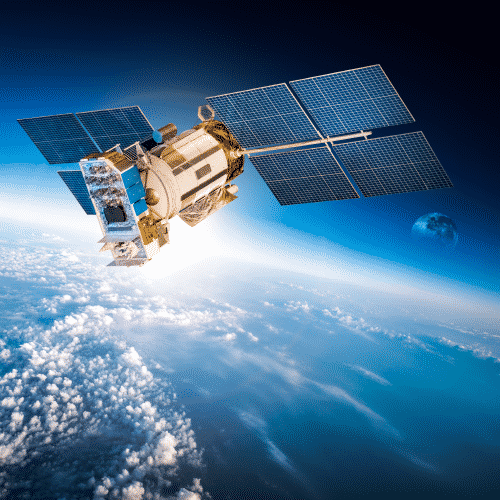
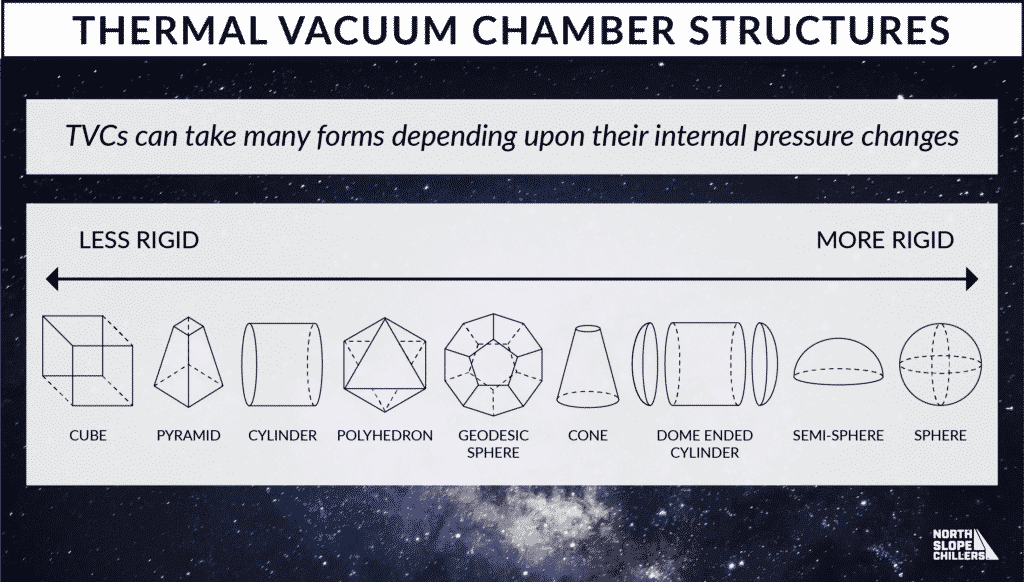
TVCs are specialized vacuum chambers that are capable of simulating environments of extreme temperatures and pressures, like those existing in the upper atmosphere and in outer space. They are built in many 3 dimensional forms, all with a range of size, strength, and rigidity.
More rigid forms can withstand collapse under high pressure differences between the chamber’s interior and exterior. Some larger volume TVCs are equipped with additional rings to increase rigidity.
Running this application in your facility?
We've built custom cooling solutions for this exact use case. Let us design one tailored to your setup.
Thermal Vacuum Chamber Applications
By creating a vacuum environment, scientists can complete a wide range of tests and experiments.
Radiative Thermal Experiments
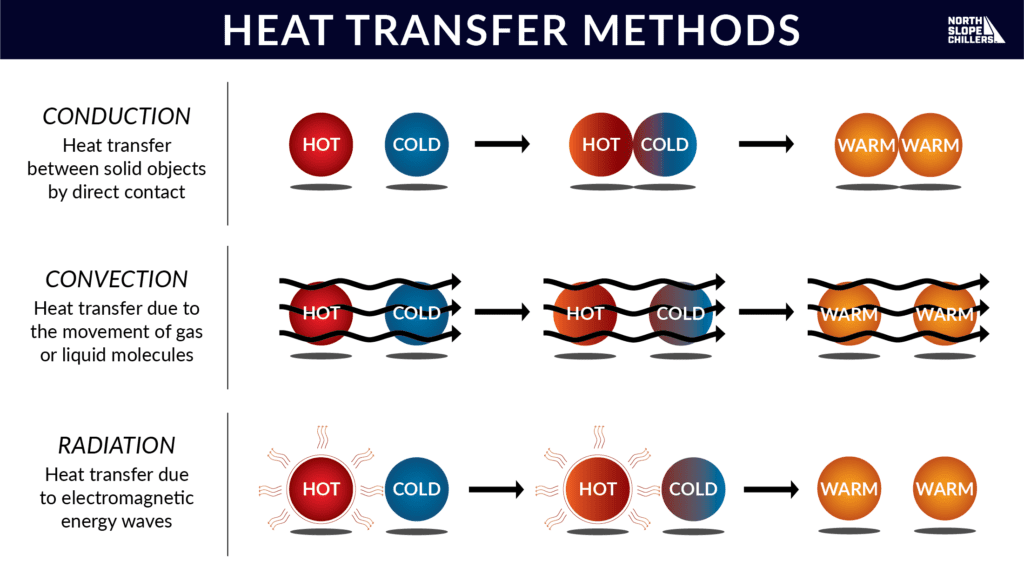
Radiation is the transmission of heat or energy waves that move through space and solid materials. In a TVC, scientists can measure how heat behaves in a vacuum with no liquid or gaseous particles to transfer it. Earth’s atmosphere provides some protection from solar radiation. In order to determine how products behave when exposed to increased levels in solar radiation, TVCs remove atmospheric gases to simulate space conditions.
Satellites and other spacecraft experience intense radiation from the sun. Scientists need to measure how much of this radiation will be absorbed by different materials and components, and what damage or deterioration will occur.
Leak Tests
Materials behave differently under different pressures and temperatures…seals can fail, seams can rupture, structural integrity can be compromised. By thoroughly testing products at various pressures, these problems can be identified and corrected before they cause safety issues.
Environmental Cycling
Do you ever wonder how manufacturers can guarantee the longevity of their products, especially when they are measured in years? Some manufacturers run their products through extensive thermal cycling that simulates high pressures and calculated increases and decreases in temperature and humidity levels. These cycles allow scientists to see how durable products are and if they withstand or breakdown after repeated exposure to extreme environments.
Survivability (Pressure Loads and Off-gassing)
Spacecraft and other vehicles are tested to ensure human passengers will stay safe and healthy inside. Aside from obvious implosion and explosion risks, some materials can also outgas and create noxious fumes in extreme environments. TVCs help make sure interior temperatures and pressures remain constant and liveable, and that no materials degrade destructively during use.
Electronic Life-Cycle Testing
Environmental fluctuations affect the usability and durability of electronic products. Ambient air is sometimes used as an insulating medium in some electronics. Changes in temperature, pressure, and humidity can alter the internal working of electronic devices. Compromised insulation in electronics can also cause arcing and electrical failure.
Measuring TVC Pressure and Temperature
Why So Extreme?
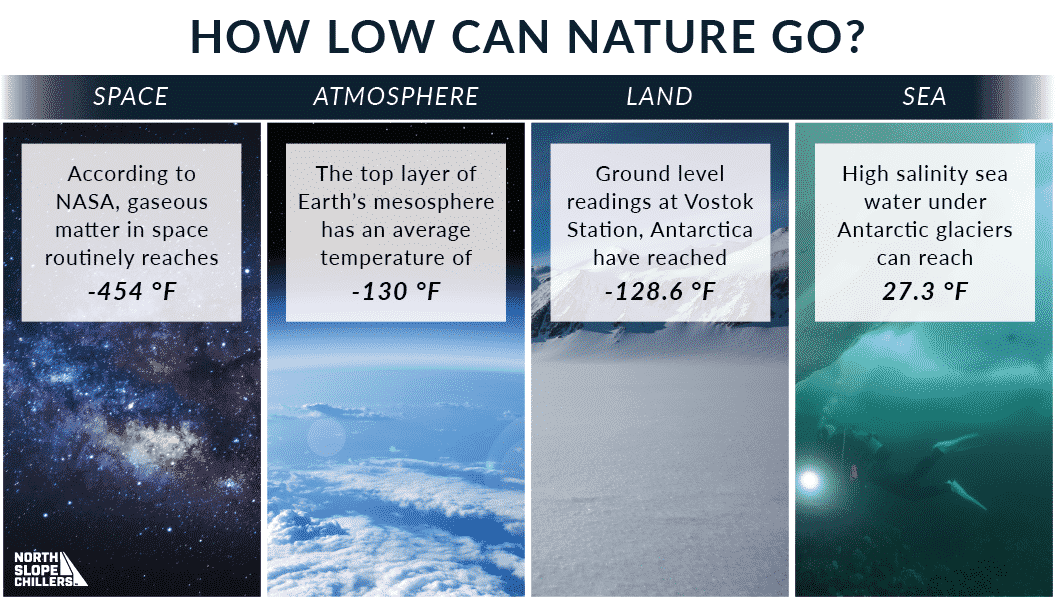
Mother nature produces a variety of environmental extremes in space, air, land, and sea. Any products (partial or whole), materials, vehicles, and electronic devices need to be thoroughly tested to make sure these extremes wont result in damage or destruction.
Temperature
At Johnson Space Center in Houston TX, NASA operates one of the largest and most advanced Thermal Vacuum Chamber facilities in the world. The various chambers are capable of reaching temperatures all the way down to -300° F and as high as 400° F.
Pressure
Pressure can be measured by many different units of measurement. The TVCs at NASA measure their pressure levels in torr; 1 torr equals exactly 1/760 of a standard atmosphere (approximately the atmospheric pressure at sea level). These chambers can create pressurized environments that range from 760 torr all the way down to 5 x 10⁻⁶ torr.
Ultra Low Temperature Chilling Solutions from North Slope Chillers
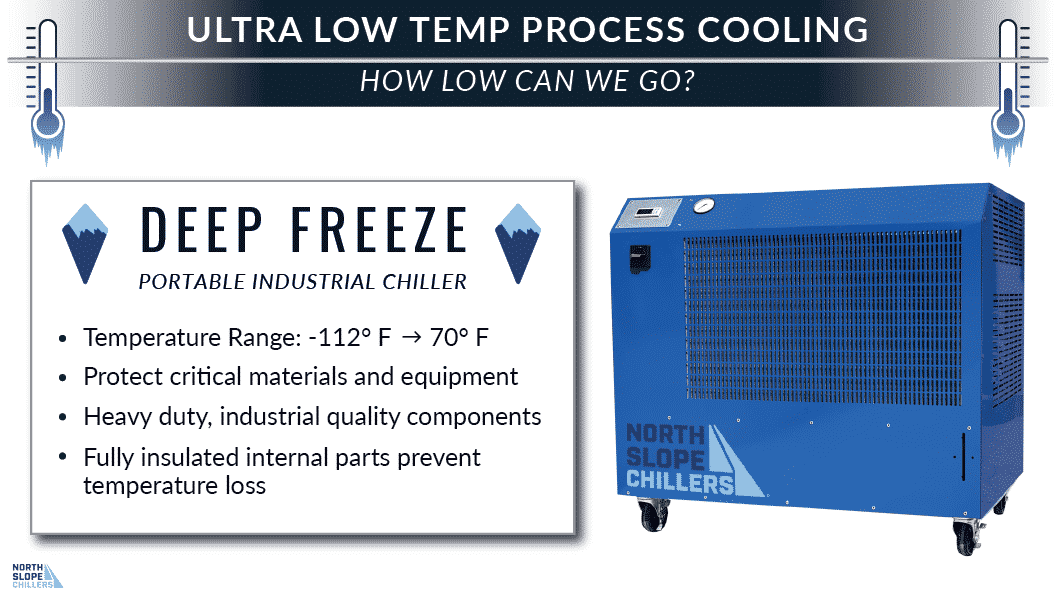
Here at North Slope Chillers, we specialize in portable and powerful industrial process cooling. Our Deep Freeze line features a wide temperature range from -112° F to 70° F. With fully insulated interior components, Deep Freeze operates efficiently with little thermal loss. If you need a liquid cooling system that is ultra cold and reliable, look to Deep Freeze. Contact us today to find the perfect ultra-low temperature solutions for your needs at (866) 826-2993 sales@northslopechillers.com
Frequently Asked Questions
What is thermal vacuum (TVAC) testing?+
Thermal vacuum testing subjects components or assemblies to combined vacuum and temperature cycling to simulate the space environment. The test chamber is evacuated to space-like pressures (10⁻⁵ to 10⁻⁷ mbar) while thermal plates or shrouds cycle temperatures between extreme hot and cold to verify hardware survivability.
How long does a TVAC test cycle last?+
A typical TVAC test runs 2–4 thermal cycles over 3–7 days, with dwell times of 4–12 hours at each temperature extreme. Some qualification tests run longer — NASA standards may require 8+ cycles over 2–3 weeks. The chiller must operate continuously throughout to maintain the cold soak temperature.
What cooling capacity is needed for TVAC chambers?+
Small TVAC chambers (1–3 feet diameter) typically need a 2-ton to 5-ton Deep Freeze chiller. Larger chambers require multi-stage cascade refrigeration systems. The cooling system must handle both steady-state cold soaks and the rapid temperature transitions between hot and cold phases.
Ready to solve your cooling challenge?
Our team has helped thousands of businesses find the right chiller solution. Let us help you next.
Keep exploring: Applications
This article is part of our Applications resource collection. Browse all the guides in this topic.