
Need help choosing the right system?
Stay Cool Around the Molten Pool
When your hand is inches away from a pool of molten metal, temperature control is of utmost importance. No glove is going to completely protect you when a TIG torch runs too long, and too hot for comfort. Water cooling gives you the time to complete high quality welds without compromising safety or weld integrity.

What is TIG Welding?
Tungsten Inert Gas welding (TIG welding) is also known as Gas Tungsten Arc Welding (GTAW). TIG welding creates high quality welds that can be used with a wide variety of metals. TIG welders use a foot pedal or finger remote to control the amperage and the heat while welding. They are thinner and provide the welder with more dexterity and flexibility than other welding torches.
Running this application in your facility?
We've built custom cooling solutions for this exact use case. Let us design one tailored to your setup.
What causes a TIG welder’s temperature to increase?
TIG Welders generate a tremendous amount of heat, and there are many factors that contribute to a torch’s temperature. These temperature variables can create thermal stress that is harmful for the equipment, the welder, and the welds.
Duration of Use
Welders have a duty cycle or period of time in which they can safely and effectively operate. The longer the welder is in use, the heat will continue to transfer through the torch handle.
Type of Shielding Gases
Shielding gases create an ideal atmosphere around the torch. Some gases (like nitrogen and oxygen) can create welding defects if present. Argon is the most common shielding gas used in welding. However including helium in the shielding atmosphere (which increases welding penetration and speeds) the temperature will also increase.
Current
In general, welding requires high currents in order to produce the heat necessary to fuse metal. TIG torches can operate with a number of amperage ranges and for some lower ranges, an air-cooled welding torch is sufficient. However, for any welding applications over 200 amps, a water cooled torch is absolutely necessary.
Distance and Angle of Torch
The space between the torch and the welding material, and the angle at which the torch is being held can also cause overheating.
Why Water Cool TIG Welders?

Using a water cooled welding chiller prevents temperature variables that you have forseen and those temperature variables that have not been forseen.
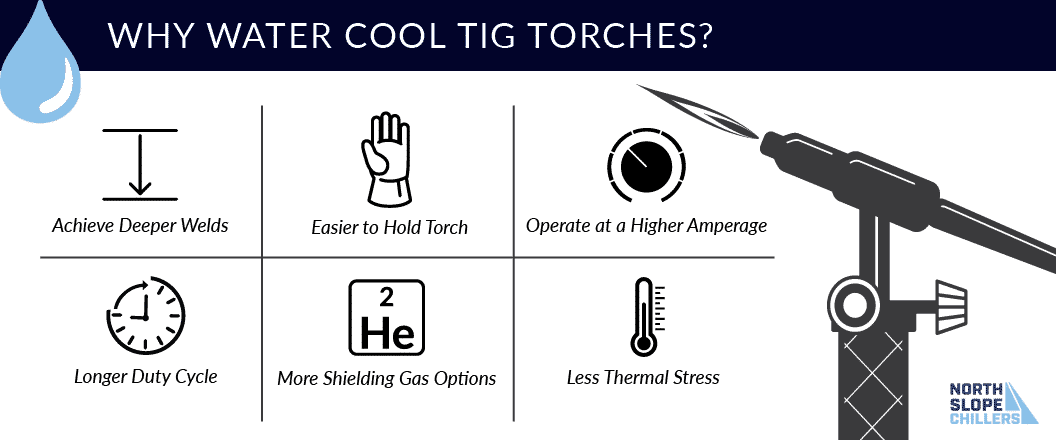
Water cooled torches have longer duty cycles without damaging the equipment. A water cooled torch is easier to hold and the welder doesn’t have to rush to finish the weld before the torch gets hot.
More effective cooling also enables a welder to use helium in the shielding atmosphere which increases the welder’s performance. Water cooled torches can also operate at a higher amperage and create a deeper fusion in the welds.
One downside to water-cooled torches is that water cooling systems can be bulky and it can be difficult to be as mobile as air-cooled torches.
North Slope Chillers offers a range of portable water cooled chillers that can help you take your welding operation anywhere.
Contact us to find the right welding cooling solution for your needs:
(866) 826-2993 sales@northslopechillers.com
Frequently Asked Questions
Why do TIG welding torches need water cooling?+
TIG welding produces intense arc heat, and the tungsten electrode concentrates this heat near the torch head. Water-cooled torches circulate coolant through the torch body and power cable, allowing continuous high-amperage welding without overheating. Air-cooled torches are limited to about 200 amps before overheating.
What coolant is used for water-cooled TIG torches?+
Most TIG torch coolers use a 50/50 mix of distilled water and propylene glycol. The glycol prevents algae growth, provides some freeze protection, and lubricates the pump. Never use tap water — minerals cause deposits in the small cooling passages of the torch body, reducing flow and cooling performance.
When should I upgrade from a torch cooler to a chiller for TIG welding?+
Upgrade to a dedicated chiller when your torch cooler cannot maintain coolant below 90°F during extended welding, when you are welding in hot environments (above 85°F ambient), when duty cycle demands exceed the cooler's capacity, or when you run multiple water-cooled torches simultaneously.
Ready to solve your cooling challenge?
Our team has helped thousands of businesses find the right chiller solution. Let us help you next.
Keep exploring: Applications
This article is part of our Applications resource collection. Browse all the guides in this topic.