
Need help choosing the right system?
We cannot overstate the importance of selecting a correctly sized chiller. Undersized chillers won’t correctly cool your process equipment or materials. Oversized chillers will work just fine, but why pay more than you need to? When you select a chiller of the proper size, you can rely on several years of efficient cooling. Let’s explore the different parameters one needs to find the perfect chiller size.
Get the Chiller Selection Guide
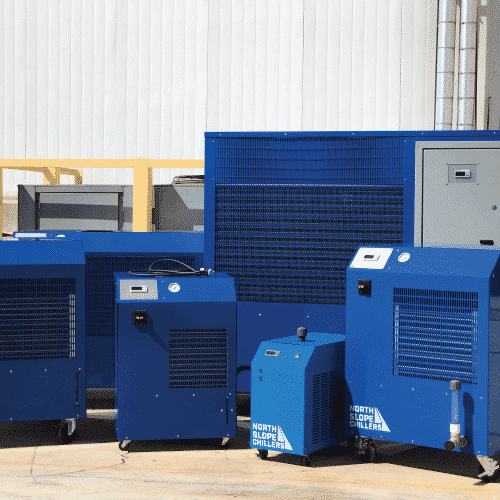
Tonnage Explained
A Historical Custom
Why are chiller sizes listed according to tons? Well, the answer lies in the cooling practices of yesteryear. Before the age of electronic air conditioners, here in North America especially, blocks of ice were harvested from frozen lakes and rivers and used to cool homes during the summertime. 1 ton of cooling power was the amount of heat transfer needed to melt 1 ton of ice blocks in a 24 hour period. As cooling technology advanced, we began to shift from stored ice to mechanical chilling. In today’s measurements, 1 ton of cooling power = 12,000 btus per hour. Just like we still measure engines according to “horsepower”, the historical practice of using “tons of refrigeration” stuck around.
Pumps and Compressors
A chiller works by using transferring heat between 2 different circuits: the fluid circuit and the refrigeration circuit. The fluid circuit moves unwanted heat into a process fluid, and the refrigeration circuit takes that unwanted heat and disperses it into the ambient air. Both circuits work together continuously to remove excess heat. The fluid circuits uses a pump to keep things flowing, and the refrigeration circuit uses a compressor. The fluid pump and the compressor are the dual engines that keep the chiller running.
Great care is used when selecting the type of pump and compressor used in our chillers. Power, flow rate, efficiency, durability, and noise levels are all taken into consideration for every chiller we offer.
Need help with your cooling calculations?
Skip the guesswork — our team can size your chiller based on your exact heat load, flow rate, and process requirements.
Volts Vs. Amps
Units of electricity can be measured in a few different ways. 2 of the most basic electrical units are used to measure the voltage (volts) and the current (amps). An easy way to understand the difference is to compare electrical flow to water flow. Imagine an electrical wire as a pipe. The voltage (volts) would be the same as measuring the water pressure, and the current (amps) would equal the amount of water in the pipe.
The Formula
Regardless of what you are cooling, this formula will determine your needed chiller size. Before jumping in, identify the following variables:
- Incoming water temperature
- Required chilled water temperature
- Flow rate
To illustrate how this formula works, let’s say we need to cool 4 GPM (gallons per minute) from 85 °F to 75 °F. This makes our incoming water temperature 85 °F, the required chilled water temperature 75 °F and the flow rate 4 GPM.
Calculate Temperature Differential (ΔT°F)
85°F − 75°F = 10°F
Calculate BTU/hr
(4 gpm × 60) × 8.33 × 10°F = 19,222 BTU/hr
Calculate Tons of Cooling Capacity
19,222 BTU/hr ÷ 12,000 = 1.666 Tons
Oversize by 20% & Round Up
1.666 tons × 1.2 = 1.999 → 2 ton chiller is needed
Most likely, your "Ideal Size in Tons" is not going to come out to an even 1 ton, 5 tons, 20 tons, etc. Rounding up will also help you be prepared for any unforeseen heat sources that are present in your setup.
We hope this was helpful! Of course, if you have any questions or would like us to size your chiller for you, please give us a call at (866) 826-2993 or email sales@northslopechillers.com

Frequently Asked Questions
What information do I need to size a chiller?+
To properly size a chiller you need four key inputs: the volume of fluid being cooled (gallons), the starting temperature, the target temperature, and the time allowed for cool-down. Secondary factors include ambient temperature, insulation, and whether the process adds continuous heat.
What formula is used to calculate chiller tonnage?+
The basic formula is: BTU/hr = (gallons × 8.33 × temperature change in °F) ÷ time in hours. Divide the BTU/hr result by 12,000 to get the required tonnage. Always add a 20% safety factor to account for ambient heat gain, pump heat, and system losses.
What happens if a chiller is undersized?+
An undersized chiller runs continuously at full capacity without reaching the target temperature. This causes increased energy consumption, accelerated compressor wear, higher operating costs, and failure to maintain process quality. Oversizing by 20–25% is standard practice.
Ready to solve your cooling challenge?
Our team has helped thousands of businesses find the right chiller solution. Let us help you next.
Keep exploring: Sizing & Calculations
This article is part of our Sizing & Calculations resource collection. Browse all the guides in this topic.