
Need help choosing the right system?
Air cooled chillers are versatile workhorses that provide cooling power to both small and large operations. Their compact design makes them portable, easy to install, and inexpensive to maintain. Let’s closely examine the inner and outer workings of air cooled chillers.
Download the Chiller Selection Guide

Air cooled chillers use the refrigeration cycle to produce chilled fluid, typically water or a mix of water and glycol. This chilled fluid is then capable of removing heat from machinery, food, or other equipment and continuously run back through the chiller.
Air Cooled vs. Water Cooled Chillers
Air cooled and water cooled chillers have many things in common. They both belong to the same vapor compression chilling family, and they both use an electronically driven mechanical compressor to force refrigerant around the system. In fact the majority of their components are the same. The main difference between the 2 is how unwanted heat is ejected from the system. Water cooled chillers pump water through a sealed condenser and disperse it through a cooling tower. Air cooled chillers use fans to force cool air across the condenser.
A water cooled chiller’s cooling tower and pump take up more space than the fans in an air cooled chiller. Because of this main component difference, air cooled chillers have a more compact footprint. Cooling towers are also more expensive to maintain, making air cooled chillers the clear lower maintenance option. In general, air cooled chillers have significantly lower upfront costs as well.
Not sure which chiller type fits your process?
Our engineers can walk you through the options and recommend the right system for your specific application.
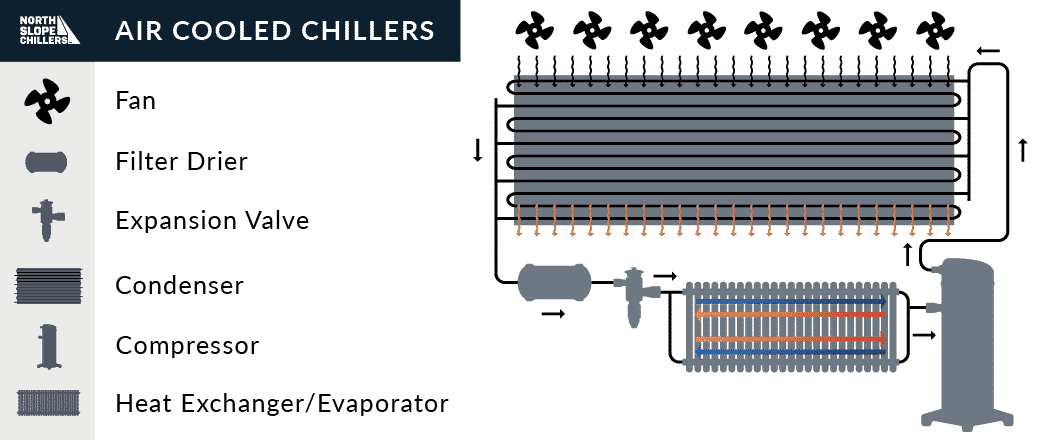
Components of Air Cooled Chillers

Compressor
The compressor provides the driving force for moving the refrigerant around the system. There are four main types of compressors. Three of them (screw, scroll, and reciprocating) use positive displacement to create pressure, and the fourth (centrifugal) creates pressure with centrifugal force.
Condenser
The condenser is a configuration of horizontal pipes through which hot refrigerant runs. Air is moved across the condenser to dissipate unwanted heat.
Condenser Fans
These fans represent the main difference between air cooled and water cooled chillers. As they move air across the condenser, unwanted heat is removed from the system so the cycle can start all over again.
Expansion Valve
The expansion valve expands the refrigerant from liquid form to gaseous form before it enters the evaporator.
Evaporator/Heat Exchanger
In the evaporator, chilled water is created when unwanted heat is drawn into the refrigerant before it is fed into the condenser.
Filter Drier
The filter drier protects your chiller by removing unwanted contaminants and moisture from the system. They do get clogged with repeated use and need to be replaced regularly.
Air Cooled Chilling From North Slope Chillers
Air cooled chillers house all of these components in a single space saving cabinet that is easily incorporated into any operation. Air cooled chillers from North Slope Chillers are portable and easy to use no matter the application. Our chillers excel at cooling lasers, welders, food storage containers, lab equipment, printers, EDM, hydroponic reservoirs, plastic injection molds, fermentation tanks, server rooms, oil extraction equipment…the list goes on and on! Contact North Slope Chillers to find the right air cooled chiller for your needs at (866) 826-2993 or sales@northslopechillers.com.
Frequently Asked Questions
What is the difference between air-cooled and water-cooled chillers?+
Air-cooled chillers reject heat to the surrounding air using fans and condenser coils, requiring no external water source. Water-cooled chillers reject heat to a water supply or cooling tower, offering higher efficiency but requiring more infrastructure. Air-cooled units are simpler to install but less efficient in hot environments.
When should I choose an air-cooled chiller?+
Choose air-cooled chillers when you lack access to a cooling water supply, want minimal installation complexity, or need a portable unit. They work best in environments where ambient air temperature stays below 95°F and adequate ventilation is available around the condenser.
Do air-cooled chillers work in hot climates?+
Air-cooled chillers lose capacity as ambient temperature rises because the temperature differential between the condenser and air decreases. Above 95°F ambient, efficiency drops significantly. In hot climates, water-cooled chillers or air-cooled units with oversized condensers are better choices.
Ready to solve your cooling challenge?
Our team has helped thousands of businesses find the right chiller solution. Let us help you next.
Keep exploring: Chiller Basics
This article is part of our Chiller Basics resource collection. Browse all the guides in this topic.