Need help choosing the right system?
Water-Cooled vs. Air-Cooled Chillers: Which One Is Right for You?
If you're picking out an industrial chiller for the first time, the very first decision you'll run into is this: air-cooled or water-cooled?
It sounds like a simple question. It's not. The wrong choice can cost you tens of thousands of dollars — in installation, electricity, or both — over the chiller's 15- to 20-year life. The right choice can quietly save you that same amount.
Here's the short answer most people are looking for, and then we'll unpack everything that goes into it.
The 30-Second Answer
- Cooling load under 100 tons? An air-cooled chiller is almost always the right answer. Simpler, cheaper to install, no cooling tower, and modern units are remarkably efficient. We build air-cooled systems all the way up to 60 tons, which covers the vast majority of industrial applications.
- Cooling load over 200 tons running long hours? A water-cooled chiller usually wins on lifetime cost, especially if you already have a cooling tower or chilled water loop.
- Somewhere in the middle? It depends on your climate, water cost, available space, and how hard the system will work. Keep reading.
If your cooling load is under 60 tons and you want to be done deciding, browse our portable air-cooled chillers (or request a custom quote for the 30–60 ton range) — that's what the vast majority of our customers in this size band end up with, and there's a reason.
Quick Comparison: Air-Cooled vs. Water-Cooled at a Glance
| Factor | Air-Cooled | Water-Cooled |
|---|---|---|
| Best capacity range | 1/3 ton – 200 tons | 50 tons – 1,000+ tons |
| Heat rejection method | Ambient air + fan | Cooling tower + water loop |
| Upfront equipment cost | $ — Lower | $$ — Higher |
| Installation complexity | Plug-and-play | Tower, piping, water treatment |
| Energy efficiency (kW/ton) | 1.0 – 1.4 | 0.6 – 0.9 |
| Water consumption | None | 2–4 gal/min per 100 tons (evaporated) |
| Footprint | Single unit | Chiller + tower + pump room |
| Noise at the chiller | 65–85 dBA | 60–75 dBA |
| Outdoor use | Designed for it | Chiller indoor, tower outdoor |
| Climate sensitivity | Loses capacity above 95°F | Performs well in any climate |
| Maintenance | Coil cleaning, fan checks | Tower cleaning, water treatment, biocide |
| Typical life | 15–20 years | 20–25 years |
How Each One Actually Works
Both chillers do the same job: pull heat out of your process water and dump it somewhere. The "somewhere" is what separates them.
Air-Cooled Chillers
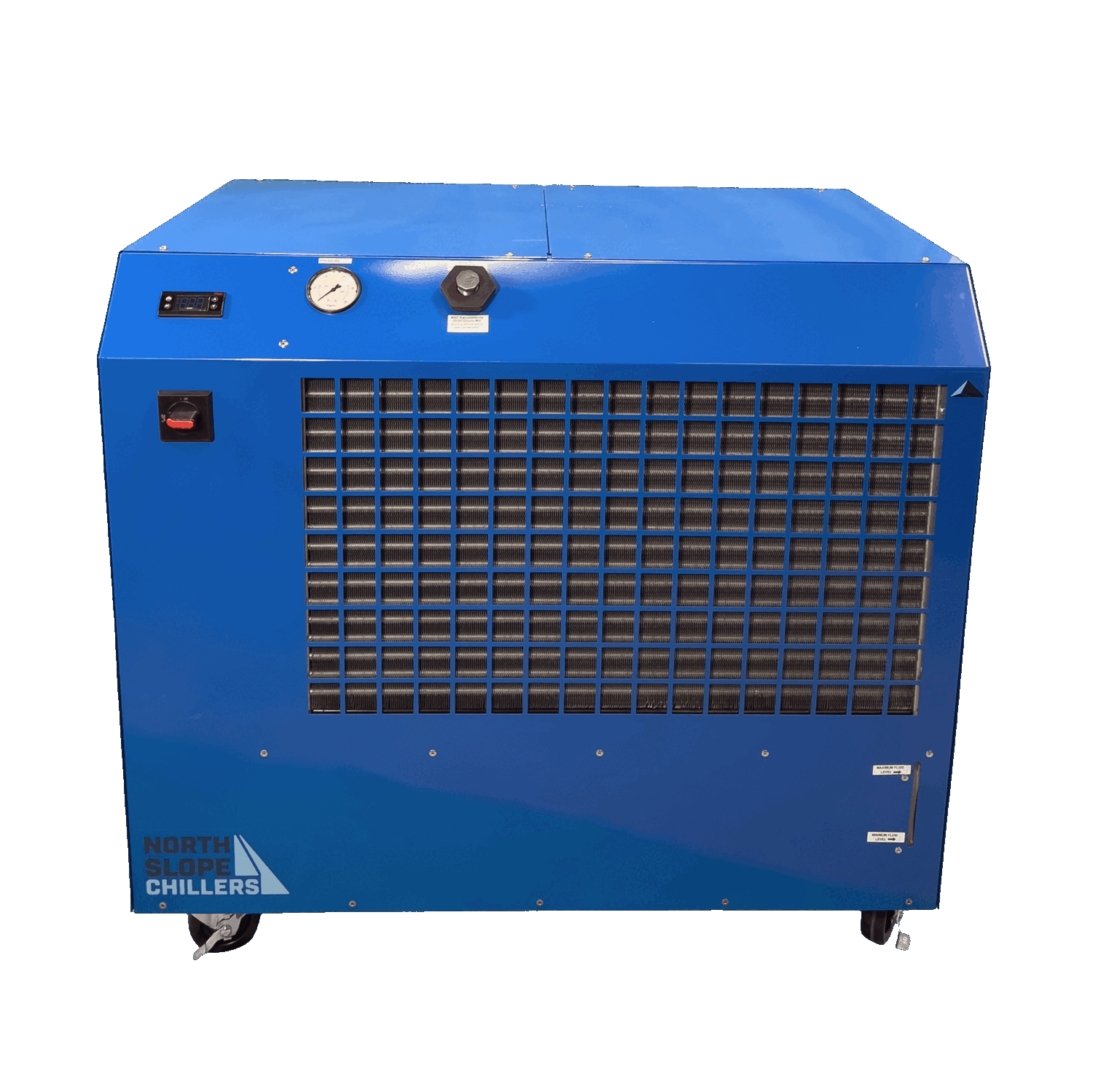
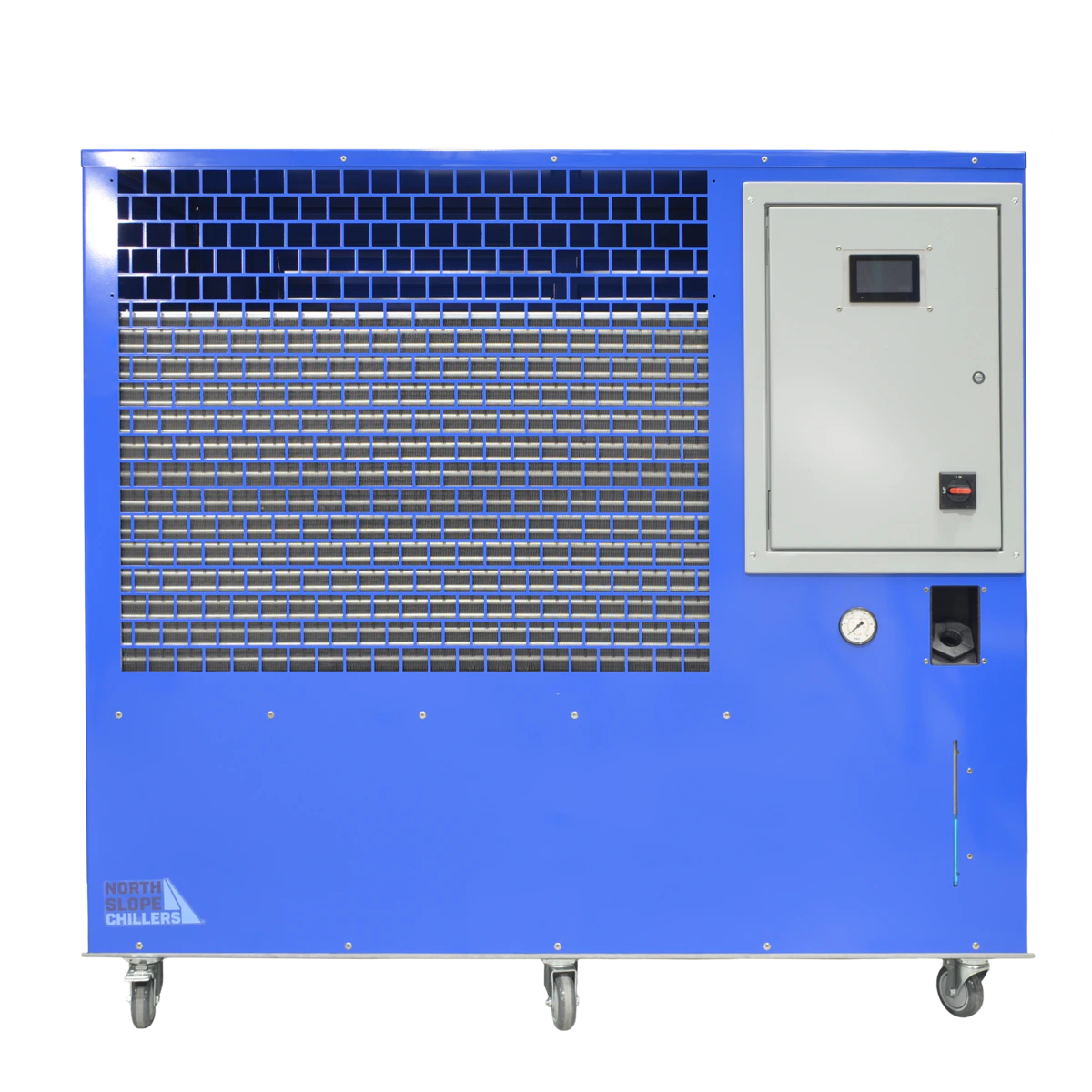
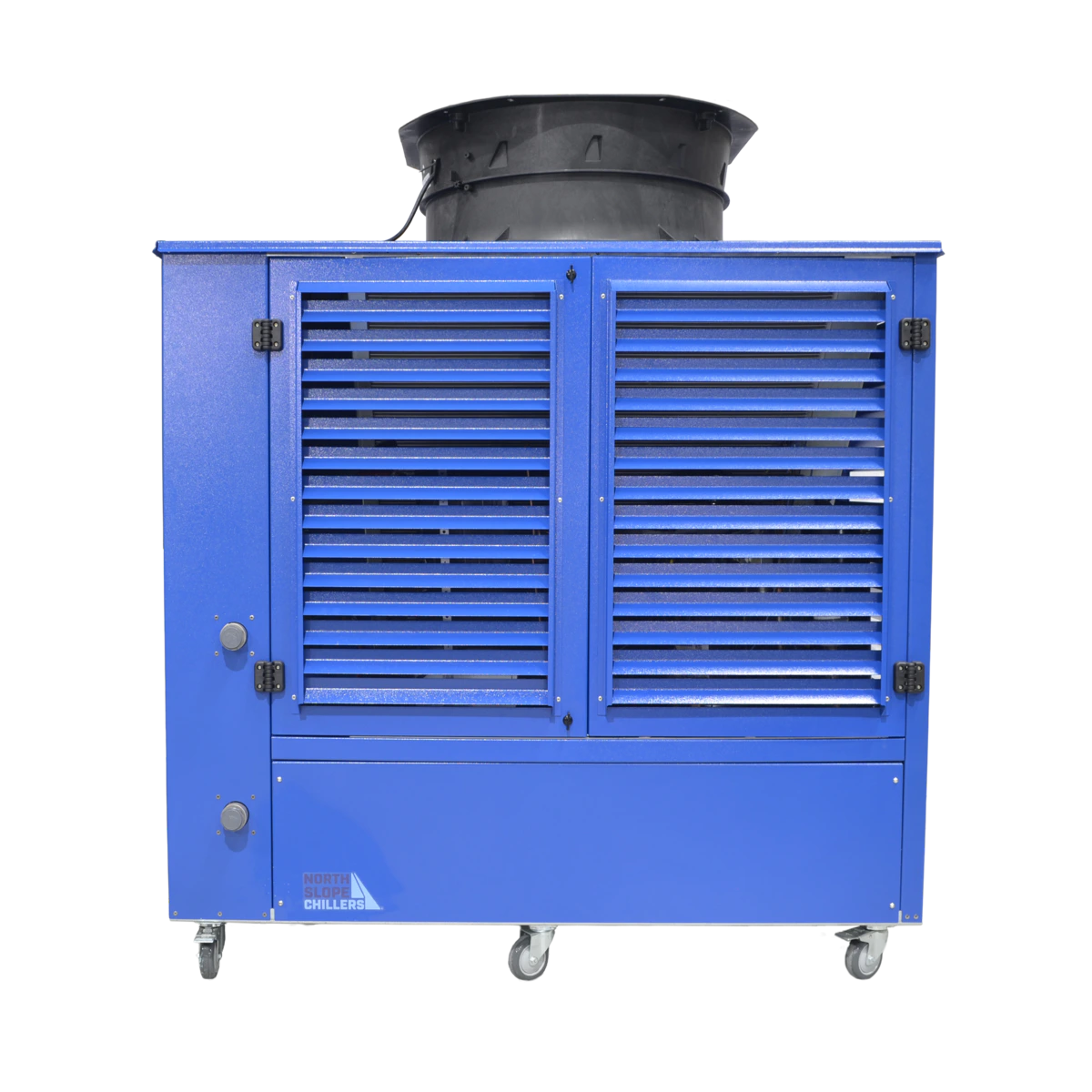
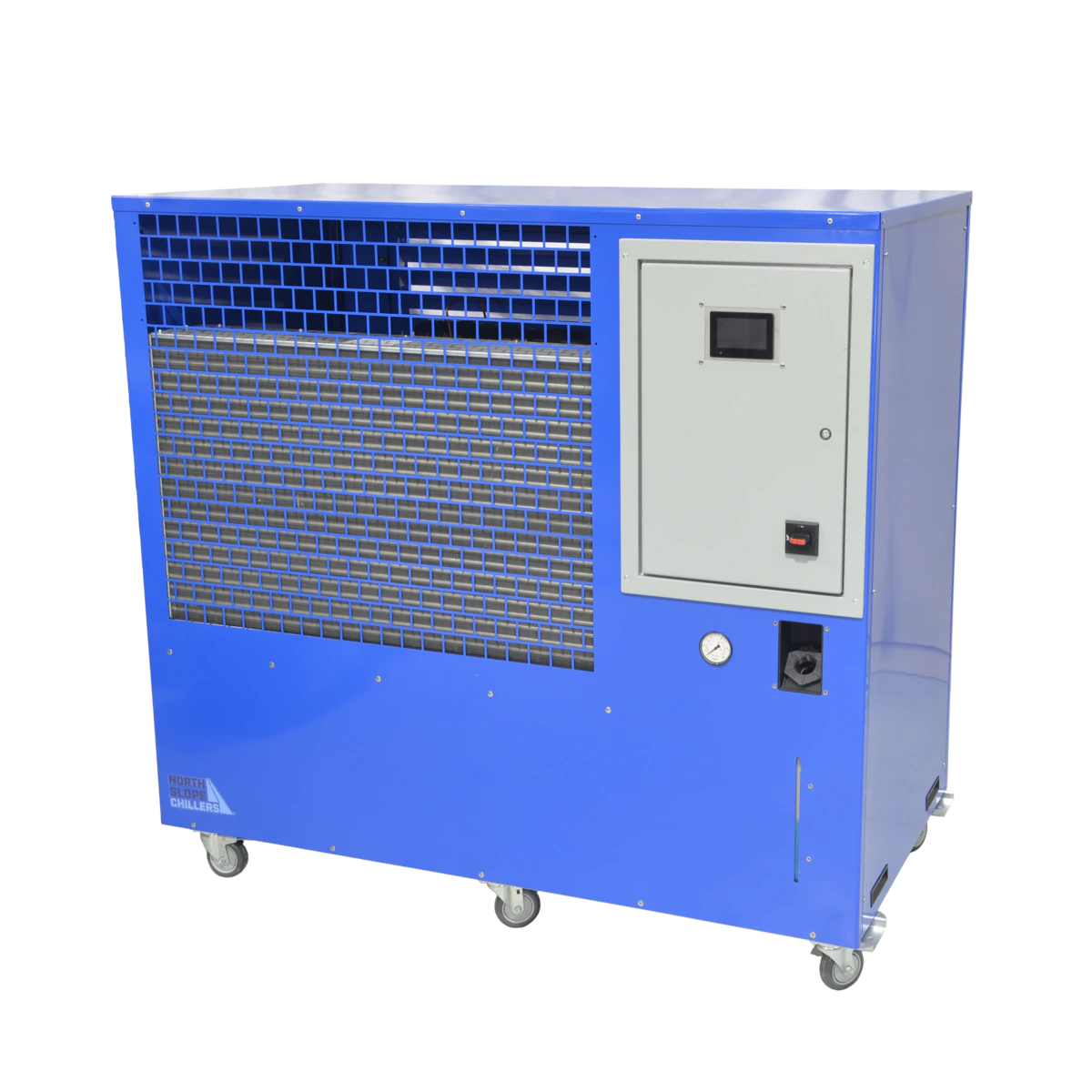
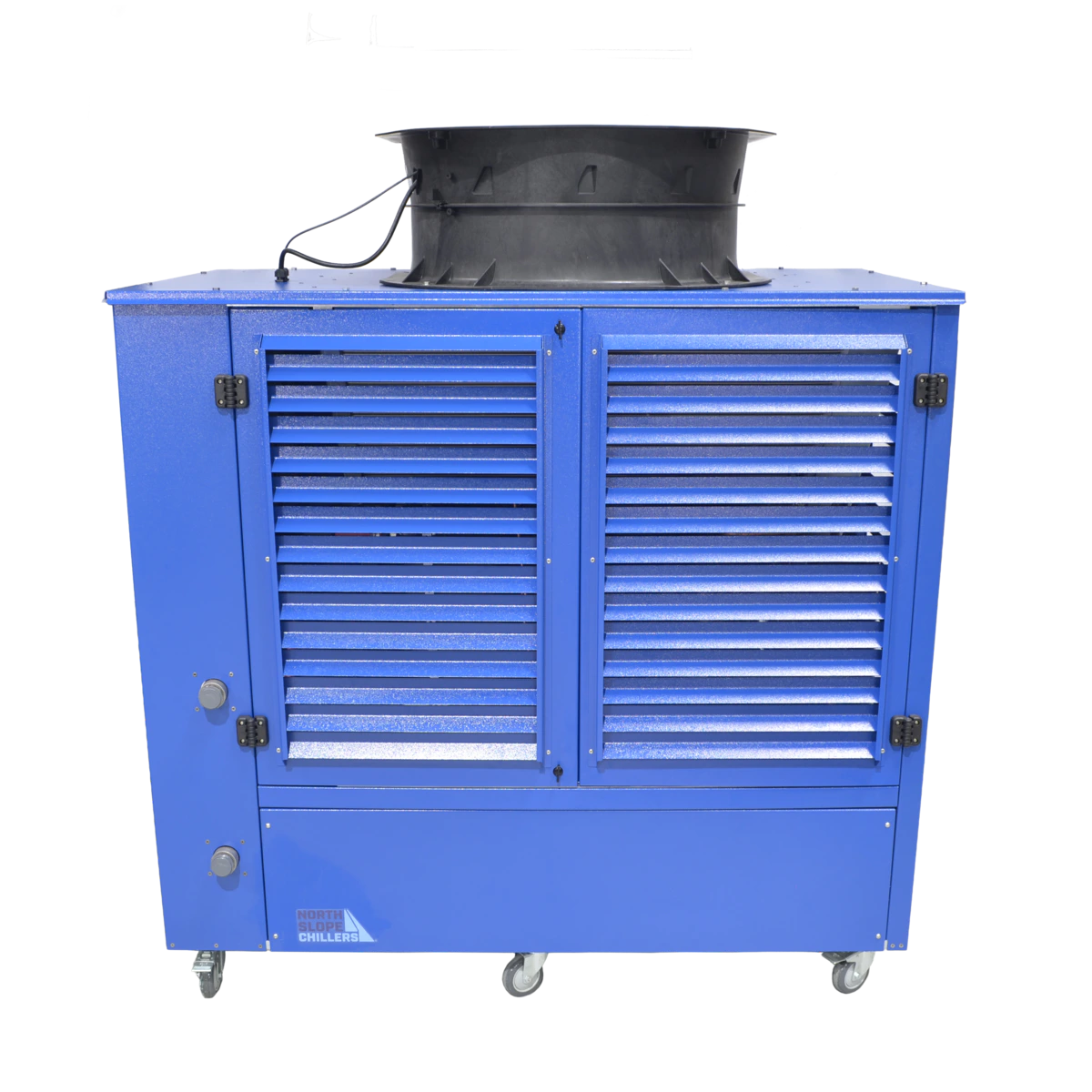
An air-cooled chiller has a refrigerant circuit (compressor, condenser, expansion valve, evaporator) and a set of fans that blow ambient air across the condenser coils. The hot refrigerant inside the coils gives up its heat to the moving air, condenses back to a liquid, and the cycle repeats.
Everything is packaged into a single unit. You plug it in, hook up your process water lines, and it runs. That simplicity is the air-cooled chiller's superpower.
Learn more about air-cooled chillers →
Water-Cooled Chillers
A water-cooled chiller works the same way, except the condenser is cooled by water instead of air. That water — called condenser water — picks up the heat and carries it to a cooling tower, where evaporation rejects the heat into the atmosphere. The cooled water then loops back to the condenser.
Water is much better at carrying heat than air, which is why water-cooled chillers are more thermodynamically efficient at scale. But you've now got three separate systems to install and maintain: the chiller, the cooling tower, and the condenser water loop.
Learn more about water-cooled chillers →
The Five Decisions That Drive Your Choice
When customers call us asking which one they need, we walk through the same five questions every time.
1. How big is your cooling load?
This is the biggest single factor.
- Under 50 tons → air-cooled, almost without exception. The cost of building a cooling tower for a small load doesn't pencil out.
- 50–200 tons → it depends on the other four factors below.
- Over 200 tons → water-cooled is usually the right call, especially for 24/7 operation.
Not sure what your cooling load is? Use our free chiller sizing tool — it walks you through the math in about two minutes.
2. What's your facility like?
- Do you have indoor space for a chiller plus condenser water pumps and piping?
- Do you have outdoor space (or a rooftop) for a cooling tower?
- Is there city water available, or are you on a well? What does water cost in your area?
- Are you in an occupied space (office building, lab) where noise matters?
Air-cooled chillers can sit outdoors and need nothing but power and process water hookups. Water-cooled chillers split into multiple components that all need somewhere to live.
3. What's your climate?
Air-cooled chiller capacity drops as ambient temperature rises. A unit rated for 10 tons of cooling at 75°F ambient might only deliver 8 tons at 95°F and 6 tons at 105°F.
If your facility is in Phoenix, Houston, Dallas, or anywhere that regularly hits triple digits, you have three options:
- Oversize the air-cooled chiller by 20–30% to compensate
- Use an adiabatic (evaporative-assist) air-cooled chiller that maintains capacity in hot weather
- Use a water-cooled chiller, which barely cares about ambient temperature
If you're in Salt Lake City, Chicago, Seattle, or anywhere with mild summers, an air-cooled chiller is essentially climate-proof.
4. How hard will the chiller actually run?
The efficiency advantage of water-cooled only matters if the chiller is on for a lot of hours. Math gets simple here:
- Light/intermittent use (less than 8 hours/day): the energy savings of water-cooled won't pay back the higher installation cost. Go air-cooled.
- Heavy use (16+ hours/day, year-round): water-cooled efficiency wins, often by tens of thousands of dollars over the chiller's life.
- Seasonal/peaking use (a few months/year): air-cooled is usually the better fit because of the lower fixed costs.
5. What's your real total cost of ownership?
Most buyers compare equipment prices and stop there. Don't.
A complete cost comparison includes:
- Equipment (chiller + tower + pumps for water-cooled)
- Installation (much higher for water-cooled)
- Electricity (lower for water-cooled at scale)
- Water and water treatment (only for water-cooled)
- Routine maintenance (much higher for water-cooled — tower cleaning, biocides, mechanical service)
- Fluid replacement (glycol, etc.)
We have a free total cost of ownership breakdown tool that takes your hours of operation, electricity rate, and water cost and shows you both options side by side over 15 years. Most customers are surprised by what they find.
Total Cost of Ownership Calculator
Estimate what a chiller will actually cost over 5 years.
Purchase
~$5,500
Electricity/yr
$576
Maintenance/yr
$300
5-Year Total
$10,280
Estimates based on approximate power consumption of 2.4 kW and typical maintenance costs. Actual costs vary by model, usage, and local rates.
Not sure which chiller type fits your process?
Our engineers can walk you through the options and recommend the right system for your specific application.
The Real-World Trade-Offs
Tables and bullet points only get you so far. Here's the practical, honest version.
Why people pick air-cooled (even when water-cooled would be slightly more efficient)
- No cooling tower to babysit. Towers need water treatment, periodic cleaning, biocide management, and Legionella monitoring. That's real labor and real liability.
- You can move it. Portable air-cooled chillers can roll between processes or follow a project. A water-cooled system is a permanent installation.
- Faster install. Plug it in, connect process water, you're cooling. A water-cooled installation is a construction project.
- Simpler service. Most facility maintenance teams can keep an air-cooled chiller running. Water-cooled systems often need a specialty contractor.
- No water bill. Cooling towers can evaporate thousands of gallons per day on a hot afternoon. In drought-restricted regions, that's a problem.
Why people pick water-cooled (even with the higher installation cost)
- Energy savings at scale. A 500-ton water-cooled plant can cut electricity costs by $15,000+ per year compared to air-cooled equivalents. Over 20 years, that's serious money.
- Climate-proof capacity. Performance doesn't degrade on hot days the way air-cooled does.
- Quieter at the chiller. Important in occupied buildings (the tower itself can sit on the roof or in a remote location).
- Already have the infrastructure. If you have a central plant or chilled water loop, adding capacity is straightforward.
- Long life. Water-cooled chillers, especially centrifugal units, routinely run 25+ years with proper maintenance.
Common Mistakes We See
- Sizing for nameplate, not real conditions. Air-cooled chillers are typically rated at 75°F ambient. If your worst-case ambient is 100°F, you need to derate or oversize.
- Ignoring the cooling tower in the cost comparison. A water-cooled chiller looks cheaper if you compare just the chiller. It's not cheaper once you add the tower, the pumps, the piping, the controls, the water treatment program, and the labor to maintain it all.
- Buying water-cooled because "it's more efficient." Efficiency only matters if the chiller runs enough hours to recover the higher install cost. For low-utilization applications, that never happens.
- Picking air-cooled in a hot climate without derating. A 5-ton chiller that delivers 3.5 tons on summer afternoons isn't really a 5-ton chiller.
- Not considering hybrid options. Modern adiabatic air-cooled chillers split the difference well — they use a tiny amount of water to maintain capacity in hot weather, without needing a full cooling tower.
Where North Slope Chillers Fits
We manufacture portable, packaged, air-cooled industrial chillers from 1/3 ton up to 20 tons in our standard (Freeze series) and low-temperature (Deep Freeze series) configurations — and up to 60 tons through our custom and OEM team. They're designed for the customers who would otherwise be over-buying a complicated water-cooled plant for what's really an air-cooled-sized job.
For applications above 20 tons (we build custom and OEM systems all the way up to 60 tons), or for any specialty integration, our custom and OEM team engineers systems tailored to your process — including hybrid and adiabatic configurations when they make sense.
We don't make cooling towers. So when a water-cooled system is genuinely the right answer for your application, we'll tell you that and point you in the right direction.
A Decision Framework You Can Use Right Now
| Your situation | Best fit |
|---|---|
| Cooling under 50 tons, any climate | Portable air-cooled chiller |
| 50–200 tons, mild climate, intermittent use | Air-cooled chiller (single or modular) |
| 50–200 tons, hot climate, heavy use | Water-cooled or adiabatic air-cooled |
| 200+ tons, 24/7 operation | Water-cooled chiller plant |
| Need to move the chiller between processes | Portable air-cooled |
| Already have a cooling tower / central plant | Water-cooled (extends existing infrastructure) |
| Drought-restricted region | Air-cooled (no water consumption) |
| Sub-zero process temperatures | Air-cooled with deep-freeze refrigerant package |
| OEM equipment that ships with cooling included | Air-cooled, integrated, custom-engineered |
Still Not Sure?
Honestly, this decision is hard to make on paper alone. The right answer depends on details about your facility, your process, and your local utility rates that are easier to talk through than to type out.
If you'd rather skip the math, request a quote with a few details about your application and we'll come back with a recommendation, a price, and an honest opinion about whether you should even buy from us in the first place. Or call our engineering team at (866) 826-2993 — most calls take less than 15 minutes and you walk away knowing exactly what you need.
You can also try our chiller sizing AI tool — answer a few questions about your process and get an instant recommendation.
Related Reading
Frequently Asked Questions
Which is more efficient — air-cooled or water-cooled chillers?+
Water-cooled chillers are generally more energy-efficient than air-cooled chillers, often by 10–30%, because water rejects heat more effectively than air. However, water-cooled systems require a cooling tower, condenser water pumps, and water treatment — and those add their own energy and operating costs. For systems under about 50 tons, air-cooled chillers are usually the more efficient overall choice once you factor in the cooling tower's energy use. For systems above 200 tons running long hours, water-cooled almost always wins.
What's the main difference between water-cooled and air-cooled chillers?+
An air-cooled chiller uses ambient air and a fan to reject heat from its condenser. A water-cooled chiller uses circulating water — typically routed through a cooling tower — to reject heat. Air-cooled chillers are self-contained and easy to install. Water-cooled chillers are more efficient at large sizes but require a cooling tower, water treatment, and more complex piping.
When should I choose an air-cooled chiller?+
Choose an air-cooled chiller when your cooling load is under 100 tons, when you don't have access to a reliable water supply, when your facility doesn't already have a cooling tower, when you need a portable or self-contained unit, when installation simplicity matters, or when you're working in a moderate climate (consistently below 95°F ambient). Most portable industrial chillers are air-cooled for these reasons.
When should I choose a water-cooled chiller?+
Choose a water-cooled chiller when your cooling load is large (typically 200 tons or more), when you already have a cooling tower or central plant infrastructure, when you operate in a hot climate where air-cooled units would lose capacity, when long-term energy efficiency outweighs higher installation costs, or when noise must be minimized in occupied spaces (the chiller itself is quieter — though the cooling tower is not silent).
Do water-cooled chillers really save money?+
Over a long lifespan and at high utilization, yes — water-cooled chillers can save 15–30% on energy compared to air-cooled. But you have to subtract the upfront cost of a cooling tower ($20,000+ for small towers, much more for large), the water treatment program, the condenser water pumps, and the maintenance labor. The break-even point is usually 5–8 years and only makes sense at higher capacities.
Can I use an air-cooled chiller outdoors?+
Yes — most industrial air-cooled chillers, including all standard North Slope Chillers Freeze and Deep Freeze units, are rated for outdoor installation. Outdoor placement actually improves performance because the condenser has unrestricted airflow. Just protect electrical components from rain and add freeze protection (glycol) for cold climates.
How loud is each type?+
Air-cooled chillers produce 65–85 dBA at the unit because of the condenser fans. Water-cooled chillers themselves are quieter (typically 60–75 dBA), but the cooling tower they depend on can be just as loud or louder. The real noise comparison depends on where you can place each piece of equipment.
What about hybrid or evaporative chillers?+
Adiabatic and evaporative-assist air-cooled chillers spray a fine water mist over the condenser coils to boost cooling capacity in hot weather. They use a fraction of the water a true water-cooled system needs while regaining most of the efficiency loss in high ambient temperatures. They're worth considering if you're stuck between an air-cooled and water-cooled decision.
Ready to solve your cooling challenge?
Our team has helped thousands of businesses find the right chiller solution. Let us help you next.
Keep exploring: Chiller Basics
This article is part of our Chiller Basics resource collection. Browse all the guides in this topic.