
Need help choosing the right system?
When your process demands reliable, high-capacity cooling, an industrial water-cooled chiller is one of the most efficient options available. Water-cooled chillers use recirculating water to reject heat, delivering consistent temperature control for applications ranging from plastics manufacturing and chemical processing to food production and data centers. Their energy efficiency and long service life make them a popular choice for facilities with moderate to heavy cooling loads. Let’s take a closer look at how water-cooled chillers work, what sets them apart from air-cooled systems, and how to choose the right one for your operation.
Download the Chiller Selection Guide
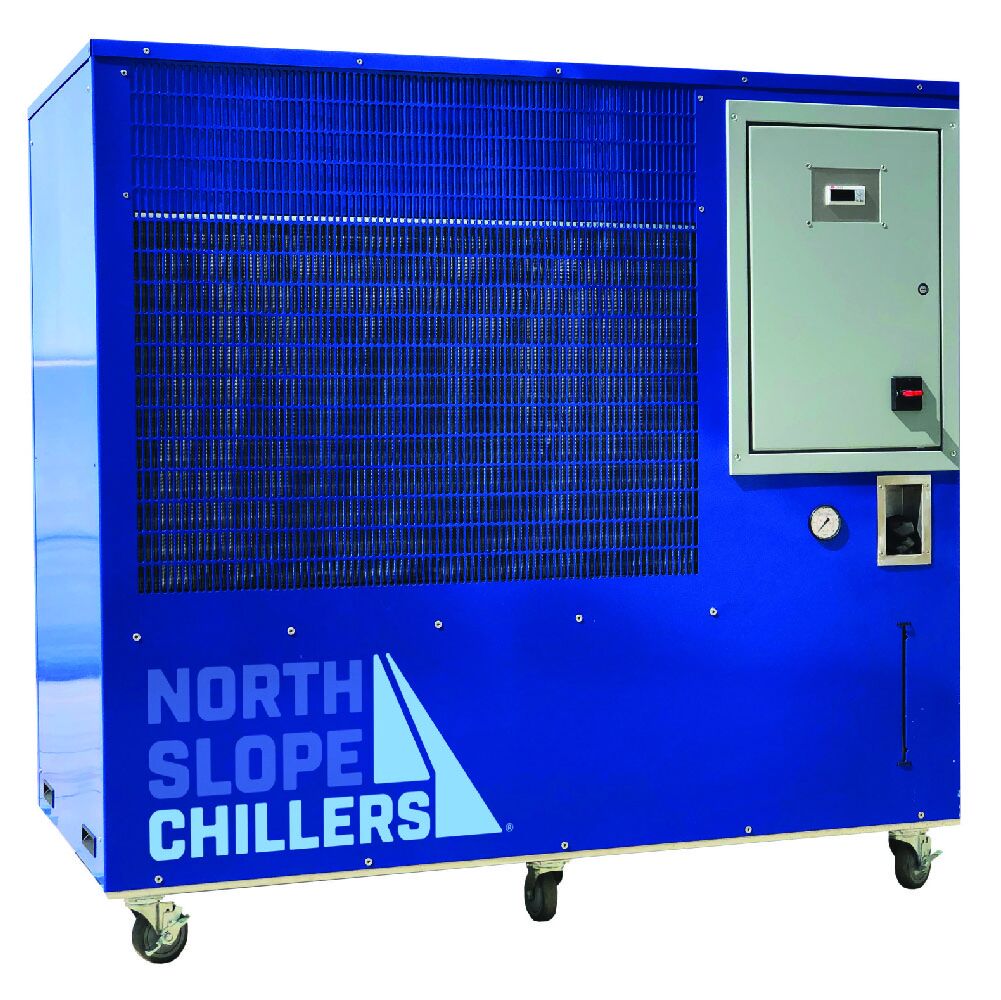
Water cooled chillers use the refrigeration cycle to produce chilled fluid, typically water or a mix of water and glycol. This chilled fluid is then capable of removing heat from machinery, food, or other equipment and continuously run back through the chiller.
Air Cooled vs. Water Cooled Chillers
Air cooled and water cooled chillers have many things in common. They both belong to the same vapor compression chilling family, and they both use an electronically driven mechanical compressor to force refrigerant around the system. In fact the majority of their components are the same. The main difference between the 2 is how unwanted heat is ejected from the system. Water cooled chillers pump water through a sealed condenser and disperse it through a cooling tower. Air cooled chillers use fans to force cool air across the condenser.
Because water is more effective at dissipating heat than air, water cooled chillers remove unwanted heat more efficiently than air cooled chillers. Water cooled chillers also are more energy efficient and last longer than air cooled chillers.
Not sure which chiller type fits your process?
Our engineers can walk you through the options and recommend the right system for your specific application.
Components of Water Cooled Chillers

Compressor
The compressor provides the driving force for moving the refrigerant around the system. There are 4 main types of compressors. 3 of them (screw, scroll, and reciprocating) use positive displacement to create pressure, and the fourth (centrifugal) creates pressure with centrifugal force.
Condenser
The condenser is a configuration of horizontal pipes through which hot refrigerant runs.
Cooling Tower
Cooling towers use evaporative cooling to remove unwanted heat. Water is pumped over the pipes carrying hot refrigerant before it is fed into the condenser.
Expansion Valve
The expansion valve expands the refrigerant from liquid form to gaseous form before it enters the evaporator.
Evaporator/Heat Exchanger
In the evaporator, chilled water is created when unwanted heat is drawn into the refrigerant before it is fed into the condenser.
Filter Drier
The filter drier protects your chiller by removing unwanted contaminants and moisture from the system. They do get clogged with repeated use and need to be replaced regularly.
Water Cooled Chilling From North Slope Chillers
Water cooled chillers from North Slope Chillers are portable and easy to use no matter the application. Our chillers are proudly made in the USA and excel at supporting a range of industries. They are perfect for cooling lasers, welders, food storage containers, lab equipment, printers, EDM, hydroponic reservoirs, plastic injection molds, fermentation tanks, server rooms, oil extraction equipment…the list goes on and on!
Contact North Slope Chillers to find the right water cooled chiller for your needs at (866) 826-2993 or sales@northslopechillers.com.
Frequently Asked Questions
What makes water-cooled chillers more efficient than air-cooled?+
Water-cooled chillers are 10–30% more efficient because water transfers heat 20 times more effectively than air. The condenser in a water-cooled chiller operates at lower pressure, reducing compressor work and energy consumption. This efficiency advantage increases in hot ambient conditions.
Do water-cooled chillers always need a cooling tower?+
Not always. North Slope Chillers' portable water-cooled chillers are designed for once-through water connections — facility tap water or a hose connection. This eliminates the need for a cooling tower, dramatically simplifying installation compared to traditional industrial water-cooled systems.
What water flow rate does a water-cooled chiller need?+
Water-cooled chillers typically require 2–3 GPM of condenser water per ton of cooling capacity. A 5-ton chiller needs approximately 10–15 GPM of condenser water flow. Insufficient flow raises head pressure and reduces chiller capacity and efficiency.
Ready to solve your cooling challenge?
Our team has helped thousands of businesses find the right chiller solution. Let us help you next.
Keep exploring: Chiller Basics
This article is part of our Chiller Basics resource collection. Browse all the guides in this topic.