
Need help choosing the right system?
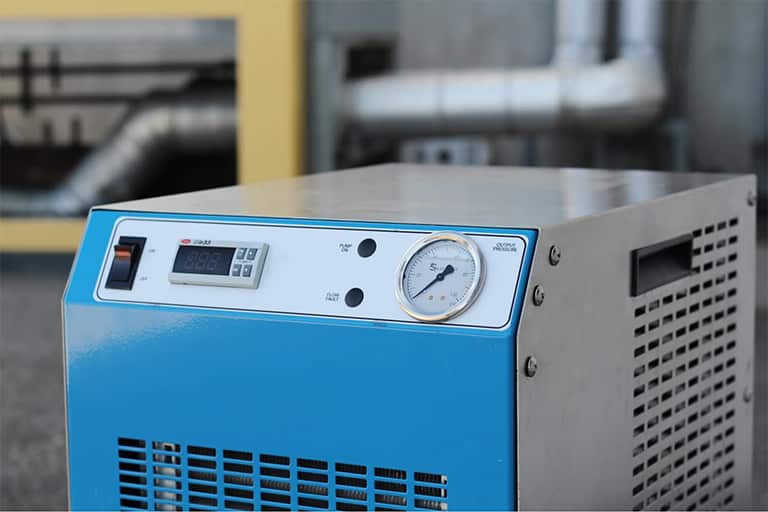
Put simply, industrial chillers help keep systems and supplies cool. Unwanted heat can cause downtime, wasted materials, slow production, and, consequently, smaller profit margins. Process chillers remove unwanted heat and keep things running smoothly, even when temperatures are high.
Chillers are used in a variety of applications including:
- Process Cooling
- Food and Beverage Production
- Chemicals
- Plastics
- Printing
- Welding
- EDM
- Lasers
Because there are so many options for types of chillers, determining what kind of chiller you need can seem daunting. Picking the wrong chiller can lead to poor results and/or wasted energy and money. Before you make your selection, it’s important to consider your specific cooling needs and to learn about the different types of chillers available.
Need help with your cooling calculations?
Skip the guesswork — our team can size your chiller based on your exact heat load, flow rate, and process requirements.
Air Cooled Chiller vs Water Cooled Chillers
Let’s take a quick look at the two main types of compression chillers. Industrial chillers use either air-cooling or water-cooling technology to operate. There are benefits to both. Your selection between the two will depend on the needs of your operation.
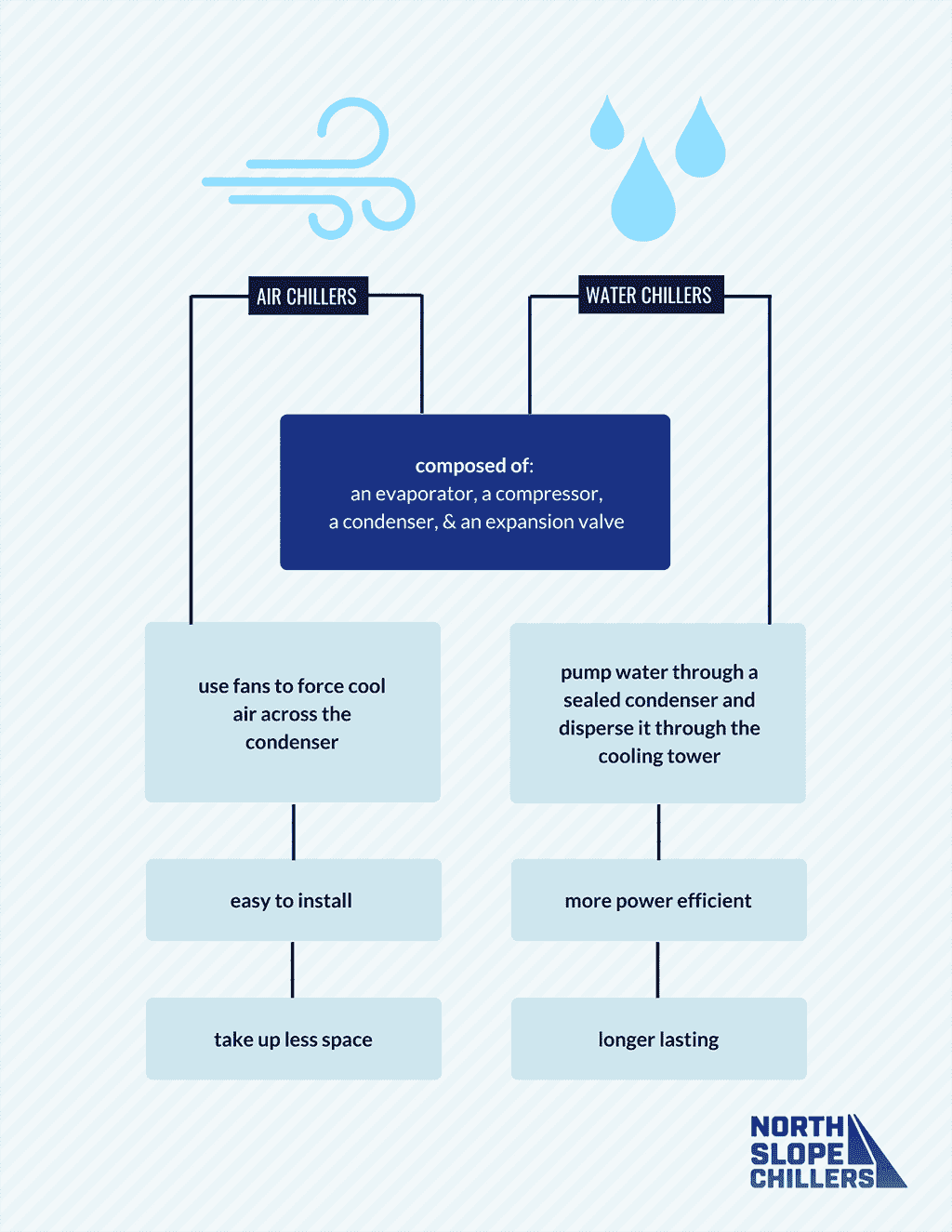
Both types of chillers are made from the same components: an evaporator, a compressor, a condenser and an expansion valve. While the mechanics of moth are fairly similar, air-cooled chillers use fans to move air across the condenser while water- cooled chillers move water through a closed condenser circuit.
Air-Cooled Chillers
Air cooled chillers can typically be installed outside, which means they require no extra interior space. This makes them a great option for stationary cooling. However, it’s important to consider that they require extra energy and are more prone to blockages (compared to water-cooled chillers).
Water-Cooled Chillers
Because water has such a high heat capacity, using water evaporation to dissipate heat is typically much more energy efficient than using air. More often than not, water-cooled chillers will be your most efficient option. Additionally, water-cooled chillers tend to last longer than water-cooled.
North Slope Chillers: Custom Options!
North Slope Chillers offers top-of-the-line chillers sized for several different needs and applications. Our chillers are made to order which means any chiller ordered from us can be customized to fit your exact requirements.
To lean more about chiller selection and to determine which type and size of chillers will best fit your needs, check out our Chiller Selection Guide.
Frequently Asked Questions
What factors determine the right chiller for my application?+
The key factors are heat load (BTU/hr), required fluid temperature, flow rate, ambient conditions, fluid type (water, glycol, DI water), and whether the chiller will be used indoors or outdoors. Secondary factors include noise requirements, available utilities (power, water), and space constraints.
Should I choose a chiller with a pump or bring my own?+
Most portable process chillers include an internal circulation pump, which simplifies installation. However, if you already have a process pump or need higher flow rates than the built-in pump provides, a chiller without a pump (or with a bypass) may be more appropriate.
How do I know if I need a standard or low-temperature chiller?+
Standard chillers (Freeze series) cool to approximately 40°F and suit most process cooling needs. If your application requires temperatures below 40°F — such as freeze drying, cold extraction, or cryogenic testing — you need a low-temperature (Deep Freeze) chiller rated to -20°F or lower.
Ready to solve your cooling challenge?
Our team has helped thousands of businesses find the right chiller solution. Let us help you next.
Keep exploring: Sizing & Calculations
This article is part of our Sizing & Calculations resource collection. Browse all the guides in this topic.