Need help choosing the right system?
Why Cooling Drums and Barrels Is So Challenging
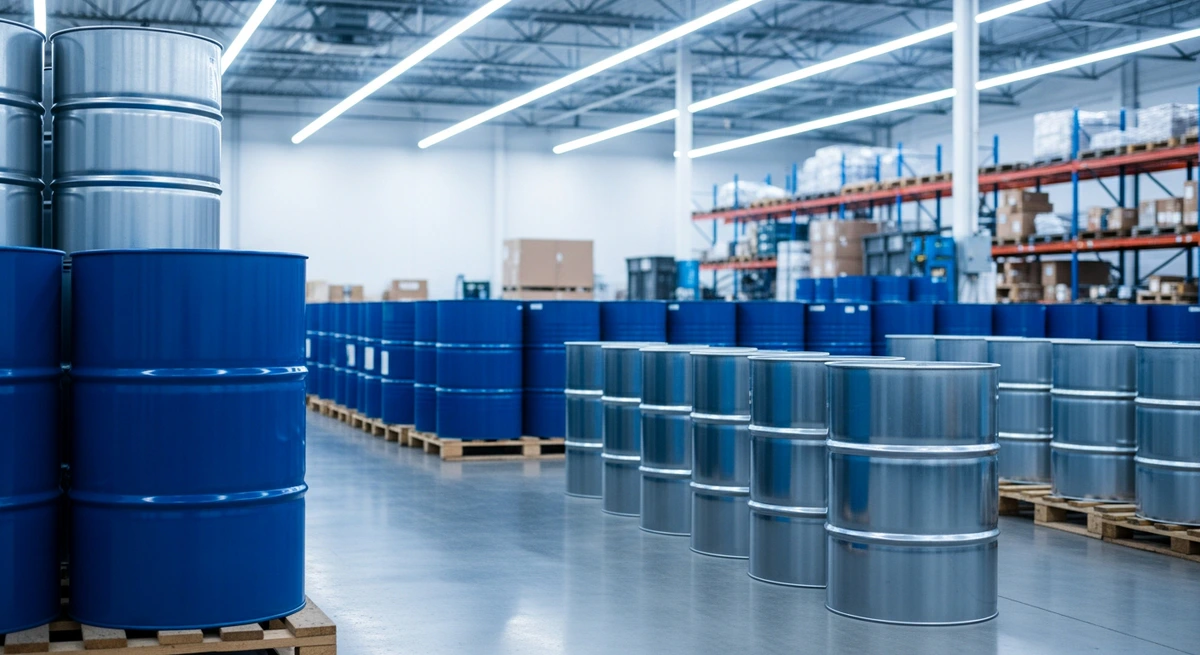
Cooling drums and barrels can be challenging, especially when dealing with temperature-sensitive liquids, chemicals, or food products. Traditional cooling methods often lack flexibility or efficiency for these applications.
Unlike jacketed tanks or vessels with built-in cooling ports, standard drums and barrels are closed containers with no designed-in method for temperature control. This creates several common challenges:
- Uneven cooling — Heat removal from one side of the drum creates temperature gradients across the contents
- Slow heat transfer — Thick steel or polyethylene walls resist efficient heat transfer
- Difficulty scaling — Traditional methods struggle when you need to cool multiple drums simultaneously
- No built-in cooling system — Standard drums aren't designed with cooling connections, making modification impractical
Understanding these challenges is the first step toward finding a solution that actually works. The key is applying process cooling directly to the container surface in a way that's uniform, efficient, and scalable.
Traditional Methods and Their Limitations
1. Ice Baths
Submerging a drum in an ice bath is one of the oldest cooling methods, but it comes with significant drawbacks:
- Inconsistent temperature control — As ice melts, the cooling rate changes unpredictably
- Labor-intensive — Requires constant monitoring and replenishment of ice
- Messy and impractical — Moving heavy drums in and out of water baths is cumbersome and creates safety hazards
- No precision — There's no way to set or maintain a specific target temperature
Ice baths might work for a one-off situation, but they're not a viable production solution.
2. Refrigerated Rooms (Walk-In Coolers)
Placing drums inside a refrigerated room seems logical, but the physics work against you:
- Extremely slow cooling — Air is a poor heat conductor compared to liquid contact. Cooling a 55-gallon drum from 120°F to 70°F in a walk-in cooler can take 24+ hours
- Energy inefficient — You're cooling the entire room volume just to reach the drum surface
- No control over individual drums — Every drum in the room is subject to the same ambient temperature
For applications that need faster cool-down or precise temperature targets, refrigerated rooms simply can't deliver.
3. Cooling Coils
Internal cooling coils provide excellent heat transfer, but they're often impractical for drum cooling:
- Requires opening the drum — Most drums are sealed, and inserting a coil means breaching containment
- Contamination risk — Introducing a coil into the product raises hygiene and purity concerns
- Not scalable — Installing coils in dozens of drums is cost-prohibitive
- Interference with contents — Coils can interfere with viscous materials, settled products, or chemical reactions
The Better Solution: Flexible Cooling Wraps + Chiller System
The most effective way to cool drums and barrels is by applying cooling directly to the container's exterior surface using a flexible cooling wrap paired with an industrial chiller. This approach solves every limitation of traditional methods.
Introducing Fluxwrap
Fluxwrap is a flexible cooling blanket engineered specifically for drums, barrels, buckets, and totes. Instead of trying to cool from inside or relying on ambient air, Fluxwrap wraps around the outside of the container and circulates temperature-controlled fluid through a proprietary multi-channel path.
How It Works
- Wrap is applied directly to the container — Fluxwrap's elastic strap design conforms tightly to the drum surface, maximizing thermal contact
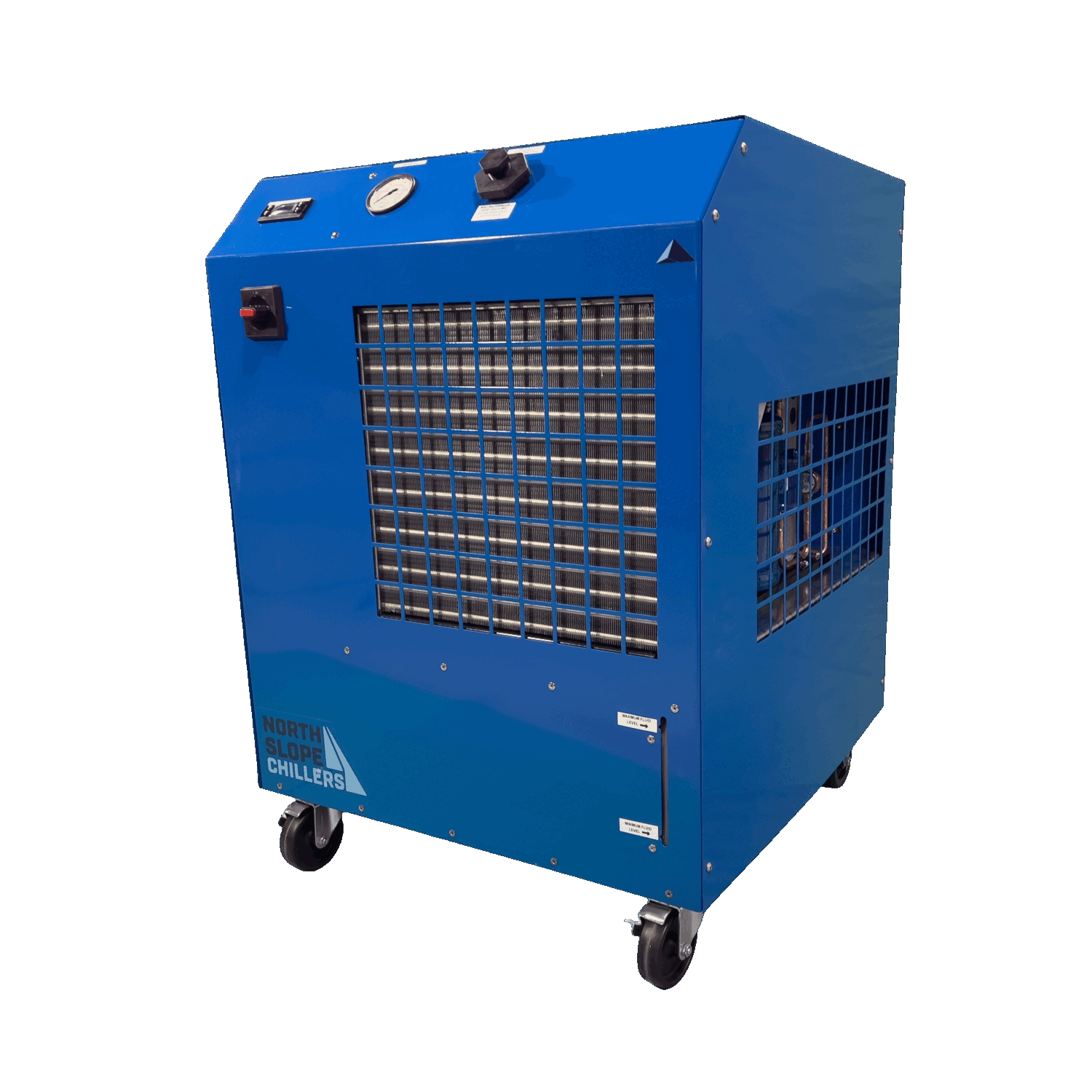
- Connected to an industrial chiller — Supply and return lines run from the wrap to a Freeze series chiller or any compatible process chiller
- Circulates cooled fluid evenly around the surface — The multi-channel fluid path distributes cooled glycol or water across the entire drum wall
- Removes heat efficiently and consistently — Heat transfers through the drum wall into the circulating fluid, then the chiller removes it and sends the fluid back — a continuous, controlled loop
Why Fluxwrap Is Better Than Traditional Methods
| Feature | Ice Bath | Walk-In Cooler | Cooling Coil | Fluxwrap |
|---|---|---|---|---|
| Temperature uniformity | Poor | Fair | Good | Excellent |
| Cool-down speed | Moderate | Slow | Fast | Fast |
| Precision control | None | Limited | Moderate | Precise |
| Scalability | Poor | Limited | Poor | Excellent |
| Labor required | High | Low | High | Minimal |
| Contamination risk | Low | None | Moderate | None |
| Works with sealed drums | Yes | Yes | No | Yes |
Key advantages of the Fluxwrap approach:
- Uniform cooling — The multi-channel design distributes fluid across the entire drum surface, eliminating hot spots
- Adaptable to different sizes — Available in 5-gallon, 15-gallon, 30-gallon, 55-gallon, and 275-gallon tote sizes
- No permanent installation — Wraps on and off in minutes, no modifications to the drum required
- Works with standard industrial chillers — Connect directly to any North Slope Chillers system
- Heating and cooling — Simply change the fluid temperature to switch from cooling to warming
Designing a cooling system from scratch?
We specialize in engineered-to-order solutions. Talk to our team about your project requirements.
The Complete System: Fluxwrap + North Slope Chiller
A Fluxwrap cooling jacket paired with a North Slope Chiller creates a complete, turnkey drum cooling system:
For a single 55-gallon drum:
- Fluxwrap 55 Gallon Drum Cooling Jacket + Freeze 1/3 Ton Chiller for steady-state maintenance
- For faster pull-downs, step up to a Freeze 1 Ton Chiller
For multiple drums or high heat loads:
- Multiple Fluxwrap jackets can run from a single larger chiller
- A Freeze 2 Ton or Freeze 5 Ton chiller can cool several drums simultaneously
For sub-freezing applications:
- Pair Fluxwrap with a Deep Freeze chiller for temperatures down to -20°F
- Use a glycol-based coolant to prevent freeze-up in the circulation lines
Use our AI Tool for a custom recommendation based on your specific drum count, fluid type, and temperature requirements.
Applications
Drum and barrel cooling is critical across many industries:
- Chemical processing — Maintain reaction temperatures, cool exothermic products after synthesis, and store temperature-sensitive chemicals safely
- Food & beverage — Cool honey, syrups, sauces, oils, and other products to required storage or processing temperatures
- Pharmaceuticals — Maintain strict temperature control for active ingredients, intermediates, and finished products
- Industrial liquids — Cool adhesives, resins, coatings, lubricants, and other viscous materials before packaging or application
- Cannabis & CBD — Temperature control during extraction, winterization, and storage of oils and concentrates
Need a Better Way to Cool Drums or Containers?
Every drum cooling application is different. Whether you're cooling a single 5-gallon bucket or a warehouse full of 55-gallon drums, we can design a system that fits your exact requirements.
Request a Quote to build a custom drum cooling solution, or talk to an engineer to discuss your application. We'll help you move past ice baths and walk-in coolers to a solution that actually performs.
Frequently Asked Questions
What is the fastest way to cool a 55-gallon drum?+
The fastest method is wrapping the drum with a Fluxwrap cooling jacket connected to an industrial chiller. This provides direct contact cooling across the entire drum surface, pulling temperatures down in hours rather than the 24+ hours a walk-in cooler would take.
Can you cool multiple drums at the same time?+
Yes. A single industrial chiller can be connected to multiple Fluxwrap jackets in parallel, cooling several drums simultaneously. A 2-ton or larger chiller is typically recommended for multi-drum setups.
Do cooling wraps work on plastic drums?+
Yes, Fluxwrap cooling jackets conform to both steel and polyethylene (plastic) drums. The flexible design adapts to slight variations in drum diameter and shape.
What temperature can drum cooling wraps reach?+
When paired with a Freeze series chiller, drum cooling wraps can maintain fluid temperatures as low as 40°F. For sub-zero applications, a Deep Freeze chiller can push temperatures down to -20°F.
Ready to solve your cooling challenge?
Our team has helped thousands of businesses find the right chiller solution. Let us help you next.
Keep exploring: System Design & Solutions
This article is part of our System Design & Solutions resource collection. Browse all the guides in this topic.